WORLD LEADING INSIGHTS

International LEADERS Calling Market Crashes Years Ahead
Second to None, Anywhere...

'Warned 2000 tech slide; predicted 2008 meltdown in 2007. Forecasted 2020 global economic collapse in 2011, AND NOW- BY 2050 - THE MOTHER OF ALL CRASHES"

Featured Post

#TROUBLE AHEAD AS #ICE SHELF DEVASTATED IN #ANTARCTIC

 REUTERS Thinning Antarctic ice shelf finally crumbles after heatwave By  Isla Binnie March 25 (Reuters) - An East Antarctica ice shelf disi...

Inspire, Achieve, Success

Search This Blog

SAVE ON HOT STUFF

Showing posts with label water. Show all posts

Monday, June 15, 2015

Canadian Leaders Know Tar Sands Huge Risk

Document Shows Canadian Government  Fully Aware of Tar Sands Dangers


A document recently released under Canada's access-to-information law reveals that Canadian government officials have been aware of the proliferation of contaminants associated with tar sands mining even as they continues to promote industry expansion with minimal regulation. The January 2015 briefing note, prepared for Natural Resources Minister Greg Rickford, discusses findings from a tar sands monitoring report published in December 2014 describing dangerous concentrations of iron and cadmium in Alberta's wetlands and of phosphorus and nitrogen in the Athabasca River.


In addition, increased concentrations of polycyclic aromatic hydrocarbons (PAH) in the toxic tailings ponds near tar sands strip mines are raising PAH levels in the atmosphere, which can lead to human health concerns like DNA damage and impaired development. The briefing note also highlights serious declines in species that rely on old forest habitat, which has been decimated by mining operations. Yet even with the knowledge furnished by this briefing note, the Canadian government has continued to promote the expansion of the tar sands industry, particularly through its support for tar sands pipelines like Keystone XL and Energy East.


We Stand On Guard For Thee


Thursday, May 28, 2015

FIRE Causes Mass Alberta Oilsands Evacuation


Alberta forest fire forces evacuation of oilsands facilities


Cenovus Energy and Canadian Natural Resources Limited have evacuated their facilities within the Cold Lake Air Weapons range, close to Alberta's eastern border, due to an out-of-control forest fire in the area.
"Yesterday, CNRL evacuated their plant facilities in the Primrose area and then, last night at 11 o'clock, we advised Cenovus in Foster Creek that it would be a good precautionary move to evacuate their personnel as well," said  Leslie Lozinski, spokeswoman for the province's environmental and resource ministry.
Cenovus evacuated their facilities at Foster Creek because the fire threatened the only road out, which would have made any evacuation of the facility difficult. Read More

 Alberta Bound??

Wednesday, April 22, 2015

DEAD SEA Is Truly Dying As #Sinkholes Grow

Sinkholes as Deep as Eight-Story Buildings Form Along Shoreline of the Disappearing Dead Sea


Sinkholes Litter Shorelines Spelling Doom For Sea


The Dead Sea is disappearing at an alarming rate, leaving behind thousands of sinkholes that are chipping away at the coastline's vibrant and touristy atmosphere.
The Dead Sea - which is actually a lake - is known for being almost 10 times as salty as the ocean and for having the lowest elevation on Earth. However, over the last few decades, the shoreline has become known for sinkholes that appear to just pop up out of nowhere.

Grand Canyon II?


More than 3,000 sinkholes exist along the banks of the Dead Sea, ABC News reported. And some of these craters dive 80 feet into the ground - the equivalent of about an eight-story building. Read More.

Dead Sea Is Drying Up


Friday, April 17, 2015

WATER CRISIS #BRAZIL - A Ghost of #Christmas Future?


Water crisis: 56 Northeastern cities 

are in situation of collapse, says 

Government


BRASILIA — in yet another Government meeting to evaluate the water crisis in part of the country, the diagnosis is that, in the Northeast, there are currently 56 cities in State of collapse, i.e. for more than four days without water.


Will IT Happen Here?


 According to the Government, there is an ongoing kite cars operation being managed by State and local governments. In the Southeast, despite the March rains, the water regime was lower than expected and the reservoirs of Rio de Janeiro and Sao Paulo are still operating below the average. Read More


Dicken's Scrooge Also Climate Allegory?


Wednesday, April 8, 2015

SAO PAULO - #Brazil - STILL DRY DESPITE RECORD RAINS


SAO PAULO STILL DRY DESPITE RECORD RAINS

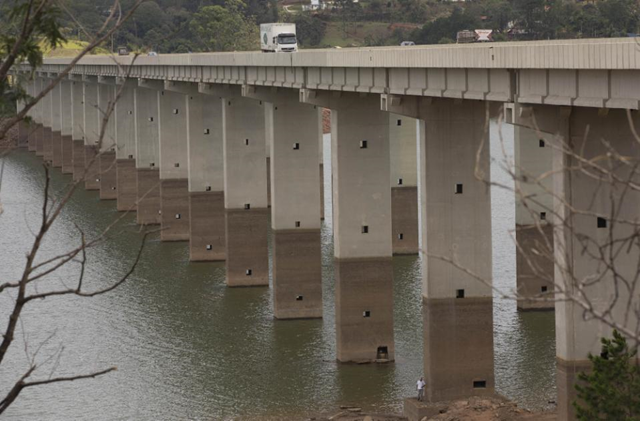
In this 29 January 2015 file photo, a bridge's columns are marked by the previous water line over the Atibainha reservoir, part of the Cantareira System that provides water to the Sao Paulo metropolitan area, in Nazare Paulista, Brazil. In 2015, Brazil's biggest city recorded its rainiest March since 2008, but the worst drought in more than 80 years has left reservoir levels critically low, and water experts fear that strict water rationing may still loom for Sao Paulo as it enters the April-September dry season. Photo: Andre Penner / AP Photo


By Stan Lehman 
2 April 2015
SÃO PAULO (Associated Press) – Brazil's biggest city has recorded its rainiest March since 2008, but the worst drought in more than 80 years has left reservoir levels critically low and water experts fear that strict water rationing may still loom for São Paulo as it enters the April-September dry season.
The crucial Cantareira water system, which provides water to about 6 million of the 20 million in the metropolitan area, was still only about one-fifth full as the dry season began.
Authorities already have imposed water-saving measures, including cut rates for people who limit usage, reduced pressure in water lines during off-peak hours and de facto rationing: some areas receive water only half the day.
Environment Minister Izabella Teixeira said this week that those programs must be expanded, and the government is preparing "a rational water-use program, given the end of the rainy season." She offered no details.
But some think that may not be enough.
Mario Thadeu Leme de Barros, head of the University of São Paulo's hydraulic engineering and environmental department, said existing measures, combined with the transfer of water among reservoirs, "will hopefully allow us to reach the end of the year with the mini-rationing that exists."
He also called for the use of more efficient appliances, the use of wastewater and better detection of leaks in a system that loses more than 30 percent of its water to leaks.
"But we cannot discard the possibility of more harsh water rationing measures should we be hit with an even worse drought during the coming dry season," he said.
Moody's Investors Service warned last month that water rationing looks increasingly likely, adding, "Overall, mandatory federal or state water rationing would worsen Brazil's already sluggish economic growth."
In March, São Paulo, received 8.13 inches (206.5 millimeters) of rain, 16 percent above the average, boosting the level of the Cantareira system from 5 percent to nearly 19 percent of its capacity, the water utility Sabesp said Thursday on its website.
The other five systems were at 23 percent to 97 percent of capacity as the dry season started.

Time For A New Rain Dance


Monday, April 6, 2015

#BBC #Mongolia Sludges Into Ecological Nightmare

The Dystopian Lake Filled By The World's Tech Lust


Hidden in an unknown corner of Inner Mongolia is a toxic, nightmarish lake created by our thirst for smartphones, consumer gadgets and green tech, discovers Tim Maughan. Black sludge pours into the lake - one of many pipes lining the shore. Photo: Liam Young / Unknown Fields

From where I'm standing, the city-sized Baogang Steel and Rare Earth complex dominates the horizon, its endless cooling towers and chimneys reaching up into grey, washed-out sky. Between it and me, stretching into the distance, lies an artificial lake filled with a black, barely-liquid, toxic sludge.
Dozens of pipes line the shore, churning out a torrent of thick, black, chemical waste from the refineries that surround the lake. The smell of sulphur and the roar of the pipes invades my senses. It feels like hell on Earth. Read More


"Rare Earth" 
Such An Ironic Twist of Words


Monday, April 21, 2014

California WATER Reserviors Drying UP


Stunning Before and After Photos of California's Lakes Depleted by Extreme Drought


By Chris Dolce


Aerial view of California's Folsom Lake, before the record drought dried it up. Photo: Google Earth
BEFORE
(Weather Channel) –

 California's reservoirs are severely depleted due to the ongoing widespread drought conditions in the state. As of 21 January 2014, 67 percent of California was in extreme drought [69% on 8 April 2014], the second worst category possible on the U.S. Drought Monitor [now 23% in “Exceptional” drought, the worst category].

According to the California Department of Water Resources, Lake Shasta and Lake Oroville are only 36 percent of capacity. Folsom Lake is just 17 percent capacity.  
Home Page
AFTER
Starting with Folsom Lake above, we've matched up recent photos of these three depleted lakes from the California Department of Water Resources with images from Google Earth that show the lakes when they were much fuller.


Read More


Here's More

Tuesday, April 15, 2014

Climate Putting More Cities Underwater

Floods leave half of Solomon Islands' capital without access to water


Authorities say it could be weeks before water supplies to the capital of Solomon Islands are restored.

9 April 2014 (Radio Australia) – Authorities say it could be weeks before water supplies to the capital of Solomon Islands are restored.

Map showing flood affected provinces in the Solomon Islands, following the record flooding in April 2014. Graphic: International Federation of Red Cross and Red Crescent SocietiesLast week, unprecedented flooding in the Pacific island nation claimed the lives of 23 people and left 9,000 homeless.

It also wreaked havoc on Honiara's water mains, with around 50 per cent of the city now unable to access water, and pipes to one of the main water supply depots broken.

Solomon Water General Manager Richard Austin said parts of the water system have been completely destroyed.

"We have two levels of problem," he told the ABC.

"We're dealing with the amount of water available in Honiara, generally, but also … provid[ing] safe basic quantities of drinking water to the evacuation centres."

Australian aid sent to help those devastated by the Solomon Island floodsAustralian Foreign Minister Julie Bishop has announced a $3 million aid package to help the flood recovery.

Australia will also boost the number of personnel in the Regional Assistance Mission to Solomon Islands (RAMSI).

There are now 16 Australian Defence Force personnel deployed in the country.

Read More


More News Reports


Tuesday, November 19, 2013

#BBC Acidic Oceans = Is Life on Venus Possible?


BBC News 
Acidic Oceans

Worst in 300 Million Years? 

 Read More Here


What is the greatest fear of all the threats that could shorten our existence on this planet - Acidic Oceans

Life began there and it is pervasive to the existence of all life support systems on the planet. Without it - our planet would become the same as Venus or Mars, having toxic atmospheres that cannot sustain any form of living creature on its surface.

The Oceans and Atmosphere are in a delicate marriage that depends on a balanced relationship amoung all their complex elements, loops and feedback systems. Should positive feedbacks of acidification begin to escalate in an exponential manner, then both the atmosphere and all forms of life are in a heap of trouble. All you have to imagine are the Oceans becoming massive acidic chemical pools covering seventy-five percent of the planet's surface. It is then easy to picture the devastating implications.

As the BBC article points out, there is growing evidence that changes are now occurring more rapidly than ever. Our concerns are many: Who is monitoring the changes? How accurate are the measures? What are the trends, and how do they forecast out? When do we reach the point of no return? Can the acidification be reversed? And many more.

Too many questions to answer - Right? But, without clear substantive answers we are all operating in the dark as to the possibility of a highly accelerated Ocean acidification occurring at virtually overnight exponential rates.


And you think the economy is a problem? Hmm. 


Dr Peter G Kinesa
November 19, 2013


Life on Venus? 


Great barrier reef


Friday, October 18, 2013

Five Billion People Face Water Scarcity


Threshold level of ΔTg leading to significant local changes in water resources (a) and terrestrial ecosystems (b). (a) Coloured areas: river basins with new water scarcity or aggravation of existing scarcity (cases (1) and (2), see section 2.3.1); greyish areas: basins experiencing lower water availability but remaining above scarcity levels (case (3)); black areas: basins remaining water-scarce but without significant aggravation of scarcity even at ΔTg = 5 °C (case (4)). No population change is assumed here. Basins with an average runoff <10 mm yr−1 per grid cell are masked out. (b) Regions with severe (coloured) or moderate (greyish) ecosystem transformation; delineation refers to the 90 biogeographic regions. All values denote changes found in >50% of the simulations. Graphic: Gerten, et al., 2013

Water Scarcity

Five Billion At Risk

By the end of this century with concurrent trending in population growth it is projected that up to five billion people could be exposed towater scarcity. These figures are according to a recent scientific research letter published in IPOScience  (read more  above).  Here’s the real scary part – that assumes that temperature does not rise 1.5 to 2 degrees Celsius over pre-industrial levels. Guess what? We are trending to go higher because restrictive measures are not being implemented.  The number should be bigger!

The report referenced provides ample numerical, mathematical and modeling analysis if you have a geeky urge.  What cannot be emphasized enough is that we are not just talking about ducks and daisies here – we are talking about the essence of human life. Climate change is not a bad dream to be swept under the media carpet, and ignoring it may not affect our lives, but the misery we are leaving our children, grand children and so on, has never been imagined by any word constructions of any dictionary on the planet.

Now, I leave you with no further words - just that thought…  

Dr Peter G Kinesa
October 17,2013
Popular Museum Attraction - 2133 AD 


Saturday, October 12, 2013

Japan's PM Sends #Fukushima SOS


Japan's PM Sends
Fukushima SOS

My country needs your knowledge and expertise”

(Al Jazeera America)
Read More Here


Almost daily the reactor at Fukushima faces new leaks of radioactive water as tanks overflow and spill their refuse into nearby seas. Over a month ago Japan had stated to the 2020 Olympic Committee, that the situation was under control. Not so, as reflected by their Prime Minister's recent call for international assistance. Japan's problems are also flowing over into the nuclear industry, that just had two multi-billion dollar projects more or less cancelled in a Canadian province.

It seems that the media is also playing down the consequences on the local fishing industry because local Sushi restaurants are in a business as usual mode. At this point it is hard to determine what the final outcomes will be until the situation is put to rest and some time has lapsed to allow for a damage assessment. There is little doubt its affects are far-reaching and may still have an impact on the larger economy as energy costs are certain to rise over time. 

Crippling the world's third largest economy is sure to have spreading global effects that may ultimately cause havoc in the global financial markets too. Therefore, it is self-evident why such a hush-hush environment exists around disclosure, events and media.

Meaning that we are going to continue monitoring developments as they are reported. Events here could dramatically change too many things, particularly when there is little evidence that they are contained or may even becoming worse?

Dr Peter G Kinesa
October 12, 2013  

Saturday, October 5, 2013

#BBC - Oceans Doomed?


Oceans Doomed?

IPSO Review Reports Decline
(BBC Article)
Read More Here

Here's another report that ties back the declining state of the Oceans to climate change, pollution, over-fishing and CO2 absorption, thus making the Oceans less alkaline and more acidic. Risking the extinction of the largest number of ocean species ever witnessed in human history. It is important to keep in mind that the health of the Oceans also impacts the speed of climate changes. They effectively feed on one another - serving to build into a rapid exponential decline in both systems that are critical to sustaining human enterprise. Fears are growing that the acidity of the Oceans is more rapid than expected, some even expect most will be acidic by the turn of this century.

Not good news!

So again, there are more and more signs that the environment is caving into the pressures of supporting ever-increasing economic activity. There may be a chance that the eco-systems are also set to continue declining, despite all efforts to immediately stop emissions and pollution. And as we know, that stoppage is not going to happen as long as we pursue endless economic and population growth. There is no sense of urgency, despite the traumatic consequences.

As a result, we can expect that natural forces will ultimately take matters into their own hands. There should be a fear that whatever occurs - could happen without much warning. Then all the urgency in the world cannot abate and remedy the deadly outcomes.

Dr Peter G Kinesa 
October 4, 2013        

Thursday, September 12, 2013

TOP ECONOMIC GRAPH - USGS GROUNDWATER : There is No Fracking Water?


Annual groundwater withdrawal estimates by water-use class from the Death Valley regional flow system, 1913 through 1998. Graphic: USGS / San Juan et al., 2010

Imagine down the road one generation is going to have to decide between whether to use and spoil groundwater for fracking oil or irrigation and farming purposes, and thus food supply. Groundwater is a key ingredient in both processes. And looking at the above graph it is apparent that the amount being used for non-agricultural reasons has been rising over the past four decades, according to this USGS report. The full report is linked above for your study.

The other obvious concern that the chart brings out; how much groundwater is there? As the population and various commercial needs grow when does demand outstrip possible supply? Right now, we do not have or see any clear answers to these questions, but hopefully someone does have them before we reach that point. Then, of course, who will decide whether you eat or drive? Hmm...

So whether it's the extinction of pollinating bugs or the exhaustion of groundwater, it looks like farming is about to become much less productive in the years ahead, despite the growing number of mouths it will be expected to feed. And that's not even taking into account what effects may come from climate change - starting with less rainfall. 

One might add - so what's all the fracking excitement about?

Dr Peter G Kinesa
September 12, 2013 


You Decide!

Motivate, Inspire, Positive