WORLD LEADING INSIGHTS

International LEADERS Calling Market Crashes Years Ahead
Second to None, Anywhere...

'Warned 2000 tech slide; predicted 2008 meltdown in 2007. Forecasted 2020 global economic collapse in 2011, AND NOW- BY 2050 - THE MOTHER OF ALL CRASHES"

Featured Post

#TROUBLE AHEAD AS #ICE SHELF DEVASTATED IN #ANTARCTIC

 REUTERS Thinning Antarctic ice shelf finally crumbles after heatwave By  Isla Binnie March 25 (Reuters) - An East Antarctica ice shelf disi...

Inspire, Achieve, Success

Search This Blog

SAVE ON HOT STUFF

Showing posts with label foodshortages. Show all posts

Friday, April 17, 2015

WATER CRISIS #BRAZIL - A Ghost of #Christmas Future?


Water crisis: 56 Northeastern cities 

are in situation of collapse, says 

Government


BRASILIA — in yet another Government meeting to evaluate the water crisis in part of the country, the diagnosis is that, in the Northeast, there are currently 56 cities in State of collapse, i.e. for more than four days without water.


Will IT Happen Here?


 According to the Government, there is an ongoing kite cars operation being managed by State and local governments. In the Southeast, despite the March rains, the water regime was lower than expected and the reservoirs of Rio de Janeiro and Sao Paulo are still operating below the average. Read More


Dicken's Scrooge Also Climate Allegory?


Friday, April 18, 2014

No Bees = NO FOOD - More #Bugonomics

Bee crisis could cost billions in lost agricultural production across Australia, Senate inquiry hears

(The Advertiser) – Feral bees have been all but wiped out in South Australia, putting the state’s agricultural industry at risk.
The state now depends on about 60 beekeepers for domestic bees to pollinate crops after the feral population was hit hard by the Bangor and Ngarkat bushfires, among others.
As the bee flies - natural pollination by native bees is seriously threatened as numbers SA apiarist Leigh Duffield, who gave evidence to a Senate inquiry into the future of beekeeping, said bees in those areas were basically burnt out, and their feeding grounds destroyed.
“No bees, no food,” he said.
“About two-thirds of the food produced in Australia is dependent on pollination. For apples, pears, lucerne, almonds, it’s about 90 per cent.
“The whole community, the health of the whole community, is now very dependent on the wellbeing of about 60 commercial apiarists in Australia. We only generate $12 million from honey, but our add-on benefit is about half a billion.”
“As a consequence it is not possible to assess the level of threat posed to the beekeeping industry in Australia, but it would seem reasonable to project that should Varroa establish in Australia and reliance on managed pollination substantially increases, then CCD will become an increasingly important issue.”

Also A Global Problem 

Monday, March 31, 2014

UN Says Climate Reducing Food Supply

Climate change 'already affecting food supply' – UN


Report by climate change panel says global warming is fuelling not only natural disasters, but potentially famine – and war
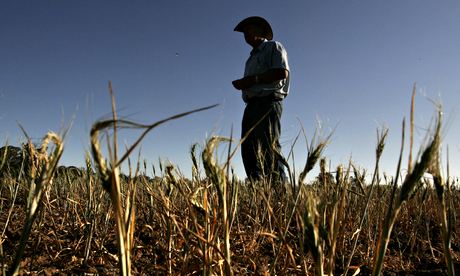
Climate change has already cut into the global food supply and is fuelling wars and natural disasters, but governments are unprepared to protect those most at risk, according to a report from the UN's climate science panel. 
Farmer wheat
Wheat could drop by 2% a decade
The report is the first update in seven years from the UN's international panel of experts, which is charged with producing the definitive account of climate change.
In that time, climate change has ceased to be a distant threat and made an impact much closer to home, the report's authors say. "It's about people now," said Virginia Burkett, the chief scientist for global change at the US geological survey and one of the report's authors. "It's more relevant to the man on the street. It's more relevant to communities because the impacts are directly affecting people – not just butterflies and sea ice."
The scientists of the Intergovernmental Panel on Climate Change found evidence of climate change far beyond thawing Arctic permafrost and crumbling coral reefs – "on all continents and across the  oceans".
But it was the finding that climate change could threaten global food security that caught the attention of government officials from 115 countries who reviewed the report. "All aspects of food security are potentially affected by climate change," the report said.


Or Watch it Melt Away...


Monday, March 17, 2014

Climate Chaos Causes Crop Failures


 crops

Climate change will reduce crop yields sooner than we thought


16 March 2014 (PhysOrg)

 – A study led by the University of Leeds has shown that global warming of only 2°C will be detrimental to crops in temperate and tropical regions, with reduced yields from the 2030s onwards.

Professor Andy Challinor, from the School of Earth and Environment at the University of Leeds and lead author of the study, said: "Our research shows that crop yields will be negatively affected by climate change much earlier than expected."

"Furthermore, the impact of climate change on crops will vary both from year-to-year and from place-to-place – with the variability becoming greater as the weather becomes increasingly erratic." 

The study, published today by the journal Nature Climate Change, feeds directly into the Working Group II report of the Intergovernmental Panel on Climate Change (IPCC) Fifth Assessment Report, which is due to be published at the end of March 2014. (Read More)


When Climate Changes... 

 
What others think-

Motivate, Inspire, Positive