WORLD LEADING INSIGHTS

International LEADERS Calling Market Crashes Years Ahead
Second to None, Anywhere...

'Warned 2000 tech slide; predicted 2008 meltdown in 2007. Forecasted 2020 global economic collapse in 2011, AND NOW- BY 2050 - THE MOTHER OF ALL CRASHES"

Featured Post

#TROUBLE AHEAD AS #ICE SHELF DEVASTATED IN #ANTARCTIC

 REUTERS Thinning Antarctic ice shelf finally crumbles after heatwave By  Isla Binnie March 25 (Reuters) - An East Antarctica ice shelf disi...

Inspire, Achieve, Success

Search This Blog

SAVE ON HOT STUFF

Showing posts with label #america. Show all posts

Tuesday, April 7, 2015

Worst Drought Ever Alters #Yosemite National Park

Drought Alters Familiar Landscape In Yosemite National Park

"Where's the waterfall?"

Hikers walk along the muddy banks of Mirror Lake on March 19, 2015 in Yosemite National Park, Calif. Tenaya Creek feeds Mirror Lake, whose banks have receded months earlier than usual, the remaining water reflects bare rock that is usually covered in snow this time of year. (Robert Gauthier/Los Angeles Times/TNS)

YOSEMITE NATIONAL PARK — Yosemite National Park is bracing for its driest year on record, with visitor bureaus downplaying the allure of the park's most famous waterfall and instead touting the park as a destination for hiking, bicycling and photography.Yosemite Falls will probably go dry in June — two months earlier than usual, parks officials say. The Merced River, which powers the spectacular Nevada and Vernal falls before meandering across the Yosemite Valley floor, will probably slow to a shallow stream about the same time.
And with the drought enabling western pine bark beetles to kill large areas of forest, the park is preparing for a bad fire season."Visitors bureaus are saying they're not going to promote Yosemite Falls as much this year," said Scott Gediman, assistant superintendent for public and legislative affairs at the park. "My response: No problem. We have to be realistic." Read more

The Wrong Kind of Changes?


Friday, October 11, 2013

#America Shrinking Brains?


America Shrinking Brains?
Score Below Average On Global Tests
(Associated Press)

American adults score poorly on global test
Read More


This should come as no surprise to anyone that the intellectual levels in the United States have been drifting lower over the past couple of decades. In fact. this trend plays havoc with demographers and media types who are constantly dumbing-down their programs and content in order to adjust to the lower common denominator. Why the shrinkage in brainpower? Numerous reasons exist; ranging from I and X toys, immigration demographics, costly elitist education, drug use, celebrity culture and poor diets, just to name a few. And in the long-run this trend will have serious economic, political, social and military implications. It is a National Security risk and huge economic disadvantage that cannot be fixed in a few years.

Beyond the tests.scoring and reported reasons maybe the deeper cause lies in the shrinkage of American leadership - the pictures captioned below tell a tale of a nation lacking in the quality of character, skills, knowledge and capabilities that its people deserve and who would act as role models for its future generations.

Dr Peter G Kinesa
October 11, 2013

Or Shrinking Leadership?  


Saturday, September 21, 2013

FIRST FINANCIAL INSIGHTS: CREDIT BUBBLE BIGGER THAN 2008

FIRST FINANCIAL INSIGHTS: CREDIT BUBBLE BIGGER THAN 2008: 
(Read More)

CREDIT BUBBLE BIGGER THAN 2008 (Also Read Recent "The Telegraph" Article )  How could credit circumstances be worse than 2008? Did we not le...

"Why would you ever trade government guaranteed bonds for highly-levered, riskier, de facto bank equity that poses as a debt instrument? Is there a smell of personal interest here?" 
International Bank Regulator - 2013

Did you ever wonder who was selling all those long treasury bonds to the Fed? Where was all that money going? Bonds? Investments? Bonuses?  Well, gleaning from the content, in both the FFI and The Telegraph articles, the money trail looks pretty clear. Here is what we make of it, in a nutshell.

Big Banks sell their bonds to the Fed, then take the proceeds and buy other Banks' debt, that may be converted to equity should the other Bank's ratio fall, say, below 10%. An event that is almost certain to occur once rates spike upwards and all the Banks have to mark to market monetary assets. Marked to market accounting of these assets is sure to result in write-offs that correspondingly affects each Bank's capital structures. These debt instruments are simply a clever way to inject capital into the banks, so that they remain solid even as the rest of us suffer when interest rates rise.


This is also what you call a "Country Club Bail-Out' that quietly escapes the attention and scrutiny of  the media, pundits, public and, of course, our brilliant politicians. So under the radar, Uncle Ben is shelling-out up to $85 Billion monthly, to shore up Banks prior to the much anticipated interest-rate driven write-offs - "without congressional authorization." Nice trick. What's worse? Even if you explained this simple shell game to those political wizards, sadly there is no guarantee they would show even a slight flicker of understanding. 

For the stability of the financial system this is, however, a good move and should avoid the recording of losses by Banks provided that the conversion price provides for an equal dollar for dollar exchange of securities. Afterwards though, the capital positions of these Banks could be exposed to market fluctuations - so it is still fraught with risk issues down the road.


Banksters should also be personally happy with this short-term bail-out insurance, provided to protect their loans, businesses and  huge bonus entitlements  Who loses? Well, in the end it's the taxpayers who are quietly bailing out the Banks, without anyone being the wiser simply because they are doing it ahead of time with an invisible financial wand. Real estate will also get clobbered, unless owners have hedged their positions; say, by shorting long bonds. And long-term the economy and future generations will get to pay the biggest price!    

Just clever, sneaky or magical finance? Or fraudulent tricks? Hmm.


Dr Peter G Kinesa

September 21, 2013  


The Real QE Magic... 
Is it DEBT or EQUITY? 


Thursday, September 12, 2013

TOP ECONOMIC GRAPH - USGS GROUNDWATER : There is No Fracking Water?


Annual groundwater withdrawal estimates by water-use class from the Death Valley regional flow system, 1913 through 1998. Graphic: USGS / San Juan et al., 2010

Imagine down the road one generation is going to have to decide between whether to use and spoil groundwater for fracking oil or irrigation and farming purposes, and thus food supply. Groundwater is a key ingredient in both processes. And looking at the above graph it is apparent that the amount being used for non-agricultural reasons has been rising over the past four decades, according to this USGS report. The full report is linked above for your study.

The other obvious concern that the chart brings out; how much groundwater is there? As the population and various commercial needs grow when does demand outstrip possible supply? Right now, we do not have or see any clear answers to these questions, but hopefully someone does have them before we reach that point. Then, of course, who will decide whether you eat or drive? Hmm...

So whether it's the extinction of pollinating bugs or the exhaustion of groundwater, it looks like farming is about to become much less productive in the years ahead, despite the growing number of mouths it will be expected to feed. And that's not even taking into account what effects may come from climate change - starting with less rainfall. 

One might add - so what's all the fracking excitement about?

Dr Peter G Kinesa
September 12, 2013 


You Decide!

Thursday, September 5, 2013

#California Smoke Gets in Your Eyes


Smoke from the Rim Fire

NASA Satellite View

Earlier we posted an important climate economic graph reflecting the upward shift in temperatures in six California regions - 1950 to 2010. If there are any doubters out there who think that a warmer climate is not causing displacements and health hazards to human conditions then they are certainly missing the tides of what may come. Major wildfires such as Yosemite pose not only health and living hazards, but the economic costs associated with containment and prevention may become overwhelming for a State already struggling with its finances.

And the wildfire damage also leads to further erosion in the quality of top soil. This means when the rains do come the coastal mountains respond by covering the scenic PCH with tons of fallen earth. Again giving rise to more costs to be born as the  sequential consequences of a warming climate   

Furthermore, fears of fire triggered by the smallest ember could lead to stricter regulations on campfires, barbecues, fireworks and maybe even smoking of any sort.These regulations would also affect other industries, commerce and tourism. At this point, no one knows what to anticipate as the climate's rising temperatures makes many areas much dryer. 

For sure, if conditions persist, the State will not be able escape deep economic consequences in the years ahead. Adding another concern to our list of non-financial metrics.

Dr Peter G Kinesa
September 5, 2013


  "On a dark desert highway, cool wind in my hair
Warm smell of colitas, rising up through the air..
 Welcome to..."
Eagles, Lyrics Hotel California


Tuesday, September 3, 2013

Top Economic Graph "CALIFORNIA STEAMING"

(Read More)

Summertime (June-August) maximum (Tmax) and minimum (Tmin) temperatures have increased between 1950 and 2010 for each of California's six climate regions. Graphic: CalEPA / OEHHA 

Here again we can look at key non-financial metrics that dig deeper into the wealth of an economy. California is already plagued by financial woes as budgetary deficits have brought the state to the brink many times. It is dancing on thin ice and requires the environment and climate to co-operate, if there is any hope of repairing fiscal issues. Not likely, as these climate graphs indicate.

Since 1950, the min and max temperatures have been increasing in all six regions in the state. Warmer temperatures means more wildfires as well as poorer growing conditions for agriculture, a major export from the state. This also means the supply of water will become more critical to serve both local fire-fighting and agricultural needs. This can only mean higher costs that will get passed on to food production; in turn consumers.

So, with this in mind we should keep a focused eye on the number and size of wildfires given their far-reaching economic implications within and outside the state. Hopefully, the Santa Ana winds don't make surfers and surfing also a past-time similar to those of California sun-bathers from millions of years ago.

Or, I wish they ought to be... 

Dr Peter G Kinesa
September 4, 2013


Land of the Endless Summer?


Friday, August 23, 2013

#Bloomberg - #Detroit Gone to the Dogs (Video)


Detroit's recent bankruptcy filing places it at the top of our list of major economic events along with the other circumstances that surround it. To many these events go beyond the horrors of a Hollywood epic. Because we know they are real!

This is a great multi-media article using both a supporting video and slide show to provide a substantive visual sense of just how bad it is on the streets of Detroit these days. There are wild hungry dogs roaming the streets; painting a picture of a lost world at damnation's edge. Raving animals who have been left behind by stressed owners unable to neither care nor feed their once beloved pets. And certainly for many of these family pets, the cycle of life mirrors the destitution of their former or current caregivers.

Bloomberg's story is a good one, reminding us that there are so many ways to view this city's plight from a human, economic, social and political perspective. Emphasizing that the determiners we use have not been enough to warn us to hit the breaks, long before the train speeds over the cliff. 

What can be learnt from this city's history - falling from the penthouse to the doghouse in less than a century? Where do we begin with our line of inquiry? Is there anything that can ever be done, particularly when global conditions are poised to worsen? 

Many questions without easy answers - and perhaps hiding omens of things to come.


Dr Peter G Kinesa
August 23,  2013


Downtown Detroit 1950's - 
Amazing Picture


Friday, August 16, 2013

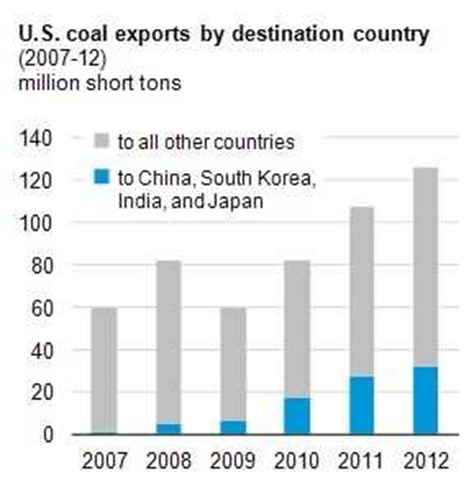
GOOD NEWS: US Coal Exports Double (2007-13)


(Read More)

U.S. coal exports by destination country, 2007-2012. Graphic: RealClearEnergy

Should we not be dancing in the streets along with the stakeholders of the coal companies experiencing unprecedented success in export sales marked by Asian customers providing even faster growth? Funny thing - what is good news for some, is bad news for others. Sure this keeps  the pressure off energy prices and perhaps defers building more nuclear plants. Also local air pollution may decrease, but other forms of environmental damage from strip and conventional mining should offset this benefit. 

The bad news starts with the fact that we are still accelerating the depletion of this non-renewable resource, despite reductions in US domestic consumption. Global air pollution and carbon emissions also increases, ensuring that we continue supporting the long-term destruction of the bio-sphere.What is ultimately more devastating is that the increase with its exponential trend in mining, means that, at some point, a future generation will simply run of another energy source. 

By then there may be a mere 14 billion living on the planet when the lights actually go out. And do you think that this might set the stage for intense wide-spread global conflicts? Hmm. So today's good news creates tomorrow's bad news. 

Ah, but who cares, every generation faces its own challenges. Right?

Dr Peter G Kinesa
August 16, 2013  

How long does the dance last?


Sunday, July 21, 2013

DETROIT Files for Bankruptcy - What Next?

DETROIT files for Bankruptcy - What Next? 


A view of downtown Detroit photographed from Belle Isle. The city park will be leased to the State of Michigan under substantially the same terms as a lease that the Detroit City Council rejected at a previously estimated savings of $6 million a year for the city. Photo: Eric Seals / Detroit Free Press


"I've got sunshine on a cloudy day; when it's cold outside I've got..."

"In a world obsessed with the crazy frivolities of celebrity, reality television, sporting events and royal births, the real important events affecting human conditions are lost in the noise of a dysfunctional media 
- we need to grow up fast"

First Financial Insights
July 20,2013  

While the news may come as a shock to some, this much anticipated event is just another cut in the demise of this once iconic American city. It was the industrial centre, a heart and soul of culture, a symbol of America and its "enterpride" that had worked to win wars and put the nation at the top of the global economic stage. Its primary automotive products changed, forever, the way we worked, lived and transported the essentials of commerce and livelihoods, from here to there. 

The old saying was "what's good for General Motors is good for America," signifying just how critical this industry and city had once been to the nation's economy. Many questions and words will be written regarding the whys, hows and whats of the industry's turn of fortune and the city's plight. Some could point to globalization, poor management, foreign competition, social decay or a host of other reasons and combinations thereof. Still what is clear is, despite the best minds, efforts and resources: it happened! - creating even bigger concerns - How many more Detroits are there? Is this just the beginning? What next?


As for sure, sound and stable economies cannot be linked to only soft, intangible and abstract industries, such as social media and entertainment - hot air can only be exchanged for so much, and particularly, as the scarcity of key economic raw materials begins to play a larger hand in global economic activity.


Perhaps, it is also time to wake-up and have a close look at how global competitors run their economies to create their sustainable comparative advantage. Apparently, they have relied less on the ideals of free enterprise and apply "National Business Strategy" to set the actions, programs and goals for their endeavours, which in some cases, results in de facto slave labour conditions. Leading us to believe that free trade - is really an oxymoron. Free for whom?

So there is certainly much more analysis that needs to be done -including what and why levels of government and management failed to address this problem in the early stages. It is a situation that did not just occur overnight, but was apparent to many and allowed to fester for many years. And how many more cities are waiting in the wings?


So we will continue to monitor the events here, and also what appears to be an emerging trend nationally, More importantly we stress, this is a global economic disease that has spread to European countries such as Cyprus, Portugal and Greece, along with nations in the Middle East who are at the forefront of social  and political upheaval.


Is the abstructionist's economy finally falling into the grips of a finite planet's physical constraints. The logical conclusion is yes. So - What Next???

Dr Peter G Kinesa

July 20, 2013


What can make me feel this way...?


Saturday, July 13, 2013

Where Have All the Fish GONE?

Where Have All the Fish GONE?


State of the world's fishery stocks, 1974 and 2009. Graphic: FAO, Fisheries and Aquaculture Department


Can you believe it? Not only are we running out of oil and many other non-renewable resources, but soon; it seems, we will also be runnung out of fish. This is much more than a staple, as fish has provided many dietary essentials, including protein, to places food alternatives are in short supply  So if you have some free time this weekend, you may want to do a quick read of the FAO report (linked above) which also covers many other foodstocks.

Recreational fishing may be a thing of the past in a few short decades or years, however the bigger concern is that populations continue to grow, while fish are dwindling in supply. Albeit there are some positive signs that with proper management some stocks have improved.  Nonetheless it is something else to think about.

Dr Peter G Kinesa
July 12, 2013 


WHAT! You mean they ate them ALL??? 


Thursday, July 11, 2013

The Marc Faber Blog - Oil Prices Moving to $500? - (Video) Bullish on Crude Oil , Bearish on India

The Marc Faber Blog - Oil Prices Moving to $500? - Bullish on Crude Oil , Bearish on India


Not a good picture!
 

Impossible! Could Never Happen! Well actually in mathematical terms it has happened a number of times before. And $500 a barrel is not that ridiculous when you think about it.- that's just a five fold increase  Compare that to the jump it took between 1971 and 1980 when it moved from $2 to $35 a barrel - a 17 fold increase. Meaning a five-fold increase is possible and more probable to occur as time goes on.

So Marc's bullish attitude towards oil is well founded and supported by growing demand from increasing populations and on-going economic growth in Asian markets. However, it is quite the opposite on the supply-side as most believe we are at or near peak extraction and can no longer add to reserves an amount equal to this consumption.

Doing some simple analysis, we confront a rather disturbing destiny. With present global consumption running at 30 billion barrels annually - equating to 300 billion every decade - total  reserves of 1.2 trillion are thus set to be practically depleted by 2053, if not sooner.

But what comes between this date and now is much more disturbing, as the world scrambles to find a way to replace the cheap energy equivalent provided by these 30 billion barrels. One thing is certain, if alternatives are found they will not be any cheaper than today's energies prices. Expect more political and social turbulence as the world seeks to rebalance this physical loss of energy inputs - that will dramatically affect food and basic transportation needs. 


To the point, we are bullish on oil and bearish on currencies whose national economies are highly dependent on imported supplies - their turbulence could be devastating. As well it will place huge downside pressure on stock and bond markets - so cash, and better yet a farm, are certain to become increasingly popular as oil prices rocket to new heights.

Dr. Peter G Kinesa
July 11, 2013


One last drop -

Friday, June 14, 2013

Marc Faber Blog: JAPAN Another Nauru? -The Japanese Stocks made a generational low in 2012 and won't go below that

Marc Faber Blog: JAPAN Another Nauru? -The Japanese Stocks made a generational low in 2012 and won't go below that

  • To begin with, no one can predict when markets will make their generational lows or highs. However, when you hide behind the adjectival nown "generational"  you sort of get away with it. Clever linguistics? In reality, in the next 20 to 30 years the writing is still on the wall for the Japanese economy, currency and markets. Indeed, one should also expect downward pressures and much lower stock prices in the next five to ten years. 

  • Here are a few reasons why we assign a strong probability to this statement. 

  • First, how soon we forget that one of the major factors contributing to Japan's WWII aggressions - was a shortage of resources needed to expand its empire. Triggering a foolhardy conflict with the United States and its allies, as it sought more oil to sustain and expand its imperial ambitions. That's a short story pointing directly at Japan's fundamental problem of having limited natural resources geographically, forcing it to import its needs under ever higher world prices and constraints.

  • After WWII, Japan's post-war miracle economy may be  attributed to a "national business strategy" of reverse-engineering major consumer products, adding technological value, exploiting a tireless workforce, and then swamping foreign markets with products at any price to entrench market share. In thirty years it became a business, financial and manufacturing giant, bringing extraordinary foreign capital flows to its shores during this prosperous time.

  • A bubble mentality, however, gripped both foreign and domestic investors, businesses and bankers;sending both stock markets and real property prices to intergalactic levels. Everyone expects things to go on and up forever - they never do! So with the ultimate collapse in asset values, Japan's global economic rank has slipped to third; while more or less, living under recessionary conditions for the past two decades. Over this period, international competition from China strengthened using a similar "national business strategy," but with the clear advantage of more and even cheaper labour supplies to exploit. Making any extended direct price competition with China today, a deadly economic battle for Japan.

  • During these decades, the country moreover experienced deep asset value deflation, while bank rates hovered at or near zero. Low interest rates for too long a period put the country into a "valuation trap," similar to what  today's global economy is experiencing, - whereby even the slightest upward move in rates should trigger unprecedented hyper-asset-deflation, spreading to depressed economic activity for an unknown extended period. Japan is now handcuffed by the consequences of earlier financial and market bubbles, with added stiffer international competition throwing more gas on the fire.
  • To compete globally, it must now look to devalue its currency  to maintain foreign capital flows and markets with competitively priced products from its domestic production . On the other hand, by devaluing its currency, foreign commodities become much more expensive, thereby restricting any strategy to be the "low cost global;producer." Because this strategy becomes harder and harder to execute, Japan's end products must now rely more on the value of subjective product innovations, in order to retain or grow market shares.
  • In all, the world has become a much tougher place for "Japan Inc," as it was once coined when it was the  post-war global darling of the business world. It is highly unlikely that Japan will ever be able to overcome its fundamental economic weakness no matter how innovative, hard-working or financially clever they become; for you cannot convince the laws and constraints of physics to change - they are simply non-negotiable. Meaning that with diminishing domestic resources, as the planet's finite resources also contract, Japan's ability to survive will be seriously tested as  it moves along the  "Nauru Paradigm" path - a road also being crowded by many other nations around the globe. A road where scarce natural resources are exhausted,while populations still continue growing. And this  mathematics can never turn  towards  positive destinations. Absolutely Impossible!.     

  • For these reasons, one can only see a setting sun on a road being well-travelled by many others. Surely, amoung many other concerns, it can only lead to much lower stock prices in the months, years and decades  ahead. Generational indeed...


  • Dr Peter G Kinesa
  • June 14, 2013


  • Finite constraints impose harsh realities-
  • LAND OF THE SETTING SUN


Saturday, June 8, 2013

Marc Faber Blog - Signs of an Imminent Market Crash Are Here

Marc Faber Blog - Signs of an Imminent Market Crash Are Here

Well, what other predictions should we expect from the highly-regarded Dr.Gloom? Not that we disagree, but we do know that precise market timing is not a science and few have ever mastered the skill with any real degree of consistency. Still, because of the long period of record low interest rates the potential for a major collapse remains in the cards, Spiking borrowing costs will deflate most financial assets in a significant way - possibly by 50% or more. Spelling big troubles for the global financial system as well as markets.

That's not all we should worry about, as social unrest is still spreading through-out the world leading to further geo-political tensions. Should these tensions cause conflicts and lead to disruptions in the supply of oil - one result would be a spike in prices of 100% or more. More importantly, food costs which have shown a high correlation with oil, would move in tandem with oil's upward price increase. Not good: as it will again lead to deeper and broader social unrest  turning to geo-political tensions, and then again spikes in the price of oil along with other non-renewal energy resources.

The picture is not good, as once the snowball begins to roll down the hill, the social-political-economic avalanche may set the stage for humanity's final chapter. Sound familiar?

Dr Peter G Kinesa
June 8, 2013 


Pending Avalanche?


Friday, May 31, 2013

Marc Faber Blog - Investors should learn to be patient

Marc Faber Blog: Investors should learn to be patient

For sure this comment needs context as Marc certainly knows that no single attribute makes a great investor. Bear in mind too, that we would classify Marc and Jimmy as traders - not investors with a kindred Warren Buffet spirit. It is a mix of skills, knowledge, character, experience and good old fashion street smarts that great investors possess.,

That's why we strongly recommend that serious investors have access to at least three types of financial advisor. Namely, building a team consisting of conventional, contrarian and maverick advisors provides a sound diversity of related skills, knowledge, experience and process. But never, ever, ever, ever place full reliance on just one advisor or related group, no matter how smart or conservative they appear; that's investor suicide, because sooner or later everyone is wrong and that could be completely devastating. 

To expand on this topic, investing requires the application of what we term "thought models" and what better person to defer to in this regard other than Charlie Munger, Warren's personal guru behind the salesman. Here's a website you may go to, that has been modeled to some degree around Charlie, that should give you some of the multiple thought processes and conceptual tools these guys keep at their disposal. 

Be patient, learn, listen and apply. But most importantly, surround yourself with investors/thinkers that are much better than you. And remember the two most paramount investing rules. First, never lose any money. And secondly, never forget the first one.

Enjoy the site and drop us line with any thoughts.


Dr Peter G Kinesa
May 31, 2013

PS. We no have affiliation economic or otherwise with this site and refer to  it for purposes of illustration and insight. Think Mental Models 


Brain's of an Oracle?


Thursday, May 30, 2013

Jim Rogers Blog - Crude Oil Outlook : known-reserves of oil continue to decline

Jim Rogers Blog - Crude Oil Outlook : known-reserves of oil continue to decline


There is one thing that can be guaranteed other than death and taxes. One day we will run out of oil that makes any sense to extract based on energy economics. Meaning that the energy needed to extract the oil far exceeds the energy value output provided by the oil. When will this occur? Based on BP's World Energy Reports probably within the next 50 years, give or take a decade. Moreover, it assumes that we do not hit the fat tail of the exponential curve sooner, thereby dramatically accelerating consumption.

But it should be emphasised that exhaustion is not the real near term concern. Rather it is "peak oil" when world consumption needs exceed the extraction outputs; and begin the decline towards exhaustion. Some experts already believe that we are at this point, while others say that it is still years ahead of us. Most, however agree that it is something that is definitely in the cards at some point, regardless.

With it comes, wars, social unrest and a breakdown in the economic and financial structures. Trade agreements and institutions such as The WTO, OEDC, IMF and the World Bank are slated for extinction as countries back into an "every man for himself" operanda. It will be a mess.


Dr Peter G Kinesa
May 30, 2013 


HEADLINE NEWS:


Motivate, Inspire, Positive