WORLD LEADING INSIGHTS

International LEADERS Calling Market Crashes Years Ahead
Second to None, Anywhere...

'Warned 2000 tech slide; predicted 2008 meltdown in 2007. Forecasted 2020 global economic collapse in 2011, AND NOW- BY 2050 - THE MOTHER OF ALL CRASHES"

Featured Post

#TROUBLE AHEAD AS #ICE SHELF DEVASTATED IN #ANTARCTIC

 REUTERS Thinning Antarctic ice shelf finally crumbles after heatwave By  Isla Binnie March 25 (Reuters) - An East Antarctica ice shelf disi...

Inspire, Achieve, Success

Search This Blog

SAVE ON HOT STUFF

Showing posts with label ecosystems. Show all posts

Monday, April 20, 2015

#Ocean Acidification Spells Extinction Backwards


Acidic Oceans

Implicated in Earth's Worst Mass 

EXTINCTION

WASHINGTON | 

Commercial fishermen and other mariners form the words ''Acid Ocean'' during an event held to spread the message of saving the oceans from acidification caused by fossil fuel emissions, in Homer, Alaska, in this file photo taken on September 6, 2009. REUTERS/Lou Dematteis

(Reuters) - It is one of science's enduring mysteries: what caused the worst mass extinction in Earth's history. And, no, it is not the one that wiped out the dinosaurs.
Scientists said on Thursday that huge amounts of carbon dioxide spewed from colossal volcanic eruptions in Siberia may have turned the world's oceans dangerously acidic 252 million years ago, helping to drive a global environmental calamity that killed most land and sea creatures.


The researchers studied rocks in the United Arab Emirates that were on the seafloor at the time and contained a detailed record of the changing ocean conditions at the end of the Permian Period. Read More.

Earth's Mass Extinctions 
"NOT "
Extraordinary Events! 
Image result for the sixth extinction timelines

Friday, May 16, 2014

Ocean Acidification Destroys #California Ecosystem


Limacina helicina shell dissolution as an indicator of declining habitat suitability owing to ocean acidification in the California Current Ecosystem


By Jeremy Hance

(mongabay.com) – It could be the plot of a horror movie: humans wake up one day to discover that chemical changes in the atmosphere are dissolving away parts of their bodies. But for small marine life known as sea butterflies, or pteropods, this is what's happening off the West Cost of the U.S. Increased carbon in the ocean is melting away shells of sea butterflies, which are tiny marine snails that underpin much of the ocean's food chain, including prey for pink salmon, mackerel, and herring.

Sea butterfly in the Limacina helicina species. Sampling sea butterflies in the species Limacina helicina off California, Washington, and Oregon in the summer of 2011, researchers found that over 50 percent of onshore sea butterflies suffered from 'severe dissolution damage'. Offshore, 24 percent of individuals showed such damage. Photo: Russ Hopcroft / University of Alaska, Fairbanks / NOAA"We did not expect to see pteropods being affected to this extent in our coastal region for several decades," said William Peterson, Ph.D., an oceanographer at National Oceanic and Atmospheric Administration (NOAA)'s Northwest Fisheries Science Center who co-authored the findings in a paper for the journal, Proceedings of the Royal Society B. 


Sampling sea butterflies in the species Limacina helicina off California, Washington, and Oregon in the summer of 2011, researchers found that over 50 percent of onshore sea butterflies suffered from "severe dissolution damage," according to the paper. Offshore, 24 percent of individuals showed such damage.

More Story...


Read More

Saturday, March 15, 2014

NASA study - Industrial Civilization to Collapse?


Industrial civilisation headed for 'irreversible collapse'?


Nasa-funded study:


Natural and social scientists develop new model of how 'perfect storm' of crises could unravel global system  

By Nafeez Ahmed

A new study sponsored by Nasa's Goddard Space Flight Center has highlighted the prospect that global industrial civilisation could collapse in coming decades due to unsustainable resource exploitation and increasingly unequal wealth distribution.
Noting that warnings of 'collapse' are often seen to be fringe or controversial, the study attempts to make sense of compelling historical data showing that "the process of rise-and-collapse is actually a recurrent cycle found throughout history." Cases of severe civilisational disruption due to "precipitous collapse - often lasting centuries - have been quite common."
The research project is based on a new cross-disciplinary 'Human And Nature DYnamical' (HANDY) model, led by applied mathematician Safa Motesharri of the US National Science Foundation-supported National Socio-Environmental Synthesis Center, in association with a team of natural and social scientists. The study based on the HANDY model has been accepted for publication in the peer-reviewed Elsevier journal, Ecological Economics.   
 (Read More)


Where is that Martian Colony?


Ridiculous - who said we have limits?


Wednesday, November 20, 2013

Global Warming is Worse - Real Climate Scientists

 
RealClimate 
Twice as Warm

Real Climate Scientists Say Global Warming Much Worse

 Read More Here


Some Like It Hot! 

That was a great movie title with some fabulous stars, but it was never intended to be applied to how we set our global thermostat. Or maybe it has another meaning?  

From the outset one should realize that there are two distinct categories of scientist: Media-Scientists and Real-Scientists. The former are the ones you often see in  the media, on talk shows and print, promoting a favoured point of view that is consistent with those of their benefactors. Very little credibility can be given to these media hucksters for obvious reasons. Real-Scientists, however, labour quietly behind the scenes seeking little public attention for their work; being most happy with their quiet professional achievements and peer approvals. They do not significantly benefit in any other ways from their work, and hence are afforded a much higher degree of trust.

So that is why when these real climate scientist tell us that global warming is double what many  believed for the past fifteen years - we believe them. But we do not do so blindly and look to other corroborating evidence to confirm their assertion. Other supporting evidence includes rising sea levels, more wildfires and floods, extreme weather turbulence, animal migrations, declining insect populations and rapidly melting glaciers and icecaps. Almost overwhelming support!

On the other hand, we also recognize that measuring the global temperature is not so simple. It is a complex process and metric because of the numerous ranges and areas that need to be measured and observed.There is no one absolute measurement or device. Therefore, some form of mathematical averaging and modelling requiring assumptions are needed, but these are also  subjective and open to influence and change. Despite this shortcoming, the integrity of the Real-Scientists who perform these complex calculations is a substantial and positive over-riding persuasion in their favour.

Read the above-attached (linked ) RealScientist  report for yourself; read other source links, go over their site and think about what else supports the report's climate temperature assertion. Then draw your own conclusions.  We did. Things are much hotter than we thought. 

And Some Don't Like It Hot!


Dr Peter G Kinesa
November 20, 2013


Who Should we Believe?
Hmm...

RealClimate logo


Tuesday, November 19, 2013

#BBC Acidic Oceans = Is Life on Venus Possible?


BBC News 
Acidic Oceans

Worst in 300 Million Years? 

 Read More Here


What is the greatest fear of all the threats that could shorten our existence on this planet - Acidic Oceans? 

Life began there and it is pervasive to the existence of all life support systems on the planet. Without it - our planet would become the same as Venus or Mars, having toxic atmospheres that cannot sustain any form of living creature on its surface.

The Oceans and Atmosphere are in a delicate marriage that depends on a balanced relationship amoung all their complex elements, loops and feedback systems. Should positive feedbacks of acidification begin to escalate in an exponential manner, then both the atmosphere and all forms of life are in a heap of trouble. All you have to imagine are the Oceans becoming massive acidic chemical pools covering seventy-five percent of the planet's surface. It is then easy to picture the devastating implications.

As the BBC article points out, there is growing evidence that changes are now occurring more rapidly than ever. Our concerns are many: Who is monitoring the changes? How accurate are the measures? What are the trends, and how do they forecast out? When do we reach the point of no return? Can the acidification be reversed? And many more.

Too many questions to answer - Right? But, without clear substantive answers we are all operating in the dark as to the possibility of a highly accelerated Ocean acidification occurring at virtually overnight exponential rates.


And you think the economy is a problem? Hmm. 


Dr Peter G Kinesa
November 19, 2013


Life on Venus? 


Great barrier reef


Monday, November 18, 2013

Never go Home? - #Fukushima

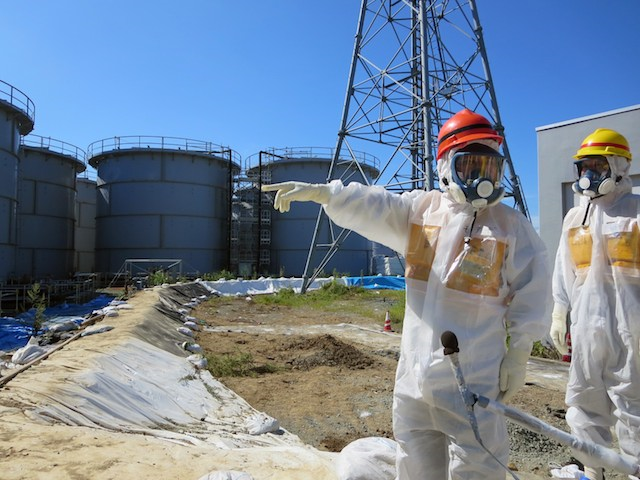
INSPECTING FUKUSHIMA. A handout picture provided by Tokyo Electric Power Co. (Tepco), shows Japanese Minister of Economy, Trade and Industry Toshimitsu Motegi (L) pointing to contaminated water storage tanks during his visit at the crippled Fukushima Daiichi Nuclear Power Plant in Okuma, northeast of Tokyo, Fukushima Prefecture, Japan, 26 August 2013. Photo: EPA / TEPCO / HANDOUT


The Guardian
Fukushima

Never Go Home?

 Read More Here


Could you imagine not being able to ever return home again for whatever reasons? Most of us would certainly be very upset and perturbed by such a situation. But that's exactly what the people who lived near the Fukushima nuclear plant are facing.

One leading Japanese Physicist remarked that had events spun out of control, then most of Northern Japan would have been uninhabitable. They are still not out of the woods yet, as there are many risks around the site that could trigger more disasters. Consequently there are many concerns that arise from this on-going situation that could also trigger a devastating financial crisis in Japan that would ripple through-out the world. Moreover, should Japan make a effort to rebuild from all this, then you can expect sharp increases in global interest rates to emerge.

Call it the Fukshima Financial Contagion - but that may be just the wake-up call we need to realize how fragile the overall energy situation is becoming. 

Dr Peter G Kinesa
November 18,2013


Home Sweet Home


Wednesday, October 23, 2013

#Fukushima Radiation - WHO's At Risk?


Fukushima
Radiation
Hitting the West Coast-
Who’s At Risk?
Read and View Video

This is not the time to get overly frightened and upset, nor is it the time to bury our heads in the sand and either hope or rationalize the dangers away. This above linked article provides anecdotal evidence with links to a variety of other stories, reporting the specific harms being done to the environment on the West Coast, possibly from the radioactive water of Fukushima. Is it possible that a distinct concentrated ocean current of this water had or could form causing such damage? - Yes, according to some scientific sources. 

Unfortunately, we cannot verify these scientific findings, conclusions and predictions one way or the other. That is one reason why we believe greater effort is needed from the world community.Moreover, the information that is coming out of Japan over the past two years has been inconsistent, contradictory and at times thought to be misleading. Contrast the effort here, to the eagerness and hyperbole surrounding efforts  to bomb Syria over its chemical weapons - and that was not even remotely threatening to North American shores. 

Again, we are not going to judge whether the risk is great or being overblown by media vigilantes, but what we do know is that this nuclear disaster has still not been contained after two years. There are indications too, that the spillage is getting worse. The Japanese Prime Minister has recently called out for global assistance. No one seems to know when this disaster is going to be fixed.These are all not adding up to a positive position for the world's third largest economy - as there are additional dangers of a major catastrophic financial fall-out spinning out of any escalated and protracted events. That would be a global event! . 

There are many known unknowns in play here, but here's the big unknown, unknown that should really concern the world.

What if there is another tsunami?  

To be quite frank, that or similar events, at this fragile point of time, is the biggest concern. We need, with the greatest urgency, to bring this  situation under control....

NOW!


Dr Peter G Kinesa
October 23, 2013


Risks of Fragile Times


Monday, October 21, 2013

#Fukushima - Out of Control?


The Japan Times 
Fukushima

OUT OF CONTROL?

See More Here


Just when you think that problems at this event could not get any worse,particularly after two years of site work. - They do!

As this linked article reports the radioactive water releases are up an astonishing 6500%.Not only is the future of Japan in the lurch, but so might be the North American western coastline as this water is sure to touch its shores. Should it be highly contaminated then you could overlay  in a few months the Fukushima wasteland pictures on cities all along the coast.  

Everyone fears what could happen should the catastrophe spread to the rest of the reactors on the site Apparently there are also 23 similar reactors in North America And this is no longer a Japanese problem. Rather, it is the world's biggest priority.


So, where is the world???


Dr Peter G Kinesa
October 21, 2013

Map of sampling locations for radioactive water leaks around the Fukushima Daiichi nuclear plant. Graphic: TEPCO 


Friday, October 18, 2013

Five Billion People Face Water Scarcity


Threshold level of ΔTg leading to significant local changes in water resources (a) and terrestrial ecosystems (b). (a) Coloured areas: river basins with new water scarcity or aggravation of existing scarcity (cases (1) and (2), see section 2.3.1); greyish areas: basins experiencing lower water availability but remaining above scarcity levels (case (3)); black areas: basins remaining water-scarce but without significant aggravation of scarcity even at ΔTg = 5 °C (case (4)). No population change is assumed here. Basins with an average runoff <10 mm yr−1 per grid cell are masked out. (b) Regions with severe (coloured) or moderate (greyish) ecosystem transformation; delineation refers to the 90 biogeographic regions. All values denote changes found in >50% of the simulations. Graphic: Gerten, et al., 2013

Water Scarcity

Five Billion At Risk

By the end of this century with concurrent trending in population growth it is projected that up to five billion people could be exposed towater scarcity. These figures are according to a recent scientific research letter published in IPOScience  (read more  above).  Here’s the real scary part – that assumes that temperature does not rise 1.5 to 2 degrees Celsius over pre-industrial levels. Guess what? We are trending to go higher because restrictive measures are not being implemented.  The number should be bigger!

The report referenced provides ample numerical, mathematical and modeling analysis if you have a geeky urge.  What cannot be emphasized enough is that we are not just talking about ducks and daisies here – we are talking about the essence of human life. Climate change is not a bad dream to be swept under the media carpet, and ignoring it may not affect our lives, but the misery we are leaving our children, grand children and so on, has never been imagined by any word constructions of any dictionary on the planet.

Now, I leave you with no further words - just that thought…  

Dr Peter G Kinesa
October 17,2013
Popular Museum Attraction - 2133 AD 


Sunday, October 6, 2013

#Fukushima - Nuclear Wasteland (In Pictures)


A woman paying a brief visit to her home walks under a sign reading 'Nuclear power – the energy for a better future', at the entrance of the empty Futaba town. Decades ago the citizens ofFutaba took such pride in hosting part of the Fukushima Daiichi nuclear complex that they built a sign over a promenade proclaiming that atomic power made their town prosperous. Photo: Damir Sagolj / Reuters

Fukushima
Nuclear Wasteland
(In Pictures)

The Guardian provides an excellent gallery of pictures providing a visual insight into the worst atomic disaster in 25 years. The human, environmental and economic costs have been staggering and what the future holds remains deeply concerning. Words can only do so much as the actual photographs touch profounder meanings and understandings of the tragedies created by a system that ignores planetary constraints with its foolish neo-classical economic beliefs pushing exponential growth leading to the self-evident ultimate minimization of human life.  

As much as these pictures convey an education into the aftermath of this event, they are also disturbing in many ways. There is a shot of a fisherman selling his catch at what appears to be a local market. His produce is covered by plastic for protection??? The first amoung many serious questions that strike the mind is, "WHO IS EATING THIS FISH?  

"... what the future holds remains deeply concerning..."

Dr Peter G Kinesa
October 5, 2013 

Motivate, Inspire, Positive