WORLD LEADING INSIGHTS

International LEADERS Calling Market Crashes Years Ahead
Second to None, Anywhere...

'Warned 2000 tech slide; predicted 2008 meltdown in 2007. Forecasted 2020 global economic collapse in 2011, AND NOW- BY 2050 - THE MOTHER OF ALL CRASHES"

Featured Post

#TROUBLE AHEAD AS #ICE SHELF DEVASTATED IN #ANTARCTIC

 REUTERS Thinning Antarctic ice shelf finally crumbles after heatwave By  Isla Binnie March 25 (Reuters) - An East Antarctica ice shelf disi...

Inspire, Achieve, Success

Search This Blog

SAVE ON HOT STUFF

Showing posts with label agriculture. Show all posts

Friday, May 22, 2015

American Bee Colonies Suffer HUGE Losses

Colony Loss 2014 – 2015: Preliminary Results


The Bee Informed Partnership (http://beeinformed.org), in collaboration with the Apiary Inspectors of America (AIA) and the United States Department of Agriculture (USDA), is releasing preliminary results for the ninth annual national survey of honey bee colony losses. For the 2014/2015 winter season, a preliminary 6,128 beekeepers in the United States provided valid responses. Collectively, these beekeepers managed 398,247 colonies in October 2014, representing about 14.5% of the country’s estimated 2.74 million managed honey bee colonies1.


Image result for bees dying cartoon


About two-thirds of the respondents (67.2%) experienced winter colony loss rates greater than the average self-reported acceptable winter mortality rate of 18.7%. Preliminary results estimate that a total of 23.1% of the colonies managed in the Unites States were lost over the 2014/2015 winter. This would represent a decrease in losses of 0.6% compared to the previous 2013/2014 winter, which had reported a total loss estimated at 23.7%. This is the second year in a row the reported colony loss rate was notably lower than the 9-year average total loss of 28.7% (see Figure 1). Read More.


Figure 1: Summary of the total colony losses overwinter (October 1 – April 1) and over the year (April 1 – April 1) of managed honey bee colonies in the United States. The acceptable range is the average percentage of acceptable colony losses declared by the survey participants in each of the nine years of the survey. Winter and Annual losses are calculated based on different respondent pools.


Dr. Kinesa's - Global Edge

If the bees go -guess who's next??


International Offices
May 22, 2015

Tuesday, April 21, 2015

#HEATWAVE - Seriously, Can #California Survive? - #Bloomberg Article

California's New Era of

Heat Destroys All

Previous Records

Sadly, this is only the beginning


The California heat of the past 12 months is like nothing ever seen in records going back to 1895. The 12 months before that were similarly without precedent. And the 12 months before that? A freakishly hot year, too. 

Where's The Polar Vortex - Extremes Everywhere? 


What's happening in California right now is shattering modern temperature measurements—as well as tree-ring records that stretch back more than 1,000 years. It's no longer just a record-hot month or a record-hot year that California faces. It's a stack of broken records leading to the worst drought that's ever beset the Golden State.  Read More


REMEMBER 
Unbelievably Sad, With Drought Comes Intenser Fire Seasons


Wednesday, April 8, 2015

SAO PAULO - #Brazil - STILL DRY DESPITE RECORD RAINS


SAO PAULO STILL DRY DESPITE RECORD RAINS

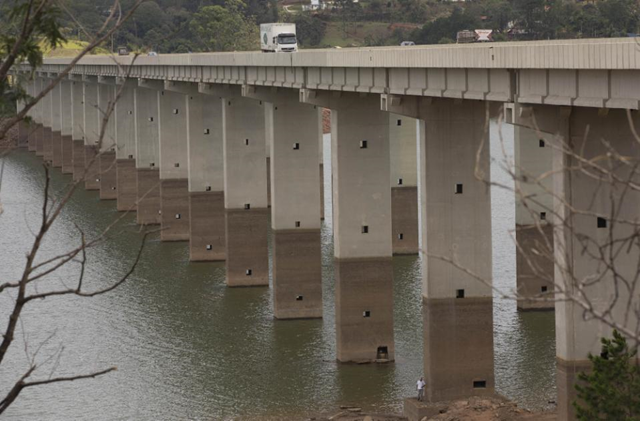
In this 29 January 2015 file photo, a bridge's columns are marked by the previous water line over the Atibainha reservoir, part of the Cantareira System that provides water to the Sao Paulo metropolitan area, in Nazare Paulista, Brazil. In 2015, Brazil's biggest city recorded its rainiest March since 2008, but the worst drought in more than 80 years has left reservoir levels critically low, and water experts fear that strict water rationing may still loom for Sao Paulo as it enters the April-September dry season. Photo: Andre Penner / AP Photo


By Stan Lehman 
2 April 2015
SÃO PAULO (Associated Press) – Brazil's biggest city has recorded its rainiest March since 2008, but the worst drought in more than 80 years has left reservoir levels critically low and water experts fear that strict water rationing may still loom for São Paulo as it enters the April-September dry season.
The crucial Cantareira water system, which provides water to about 6 million of the 20 million in the metropolitan area, was still only about one-fifth full as the dry season began.
Authorities already have imposed water-saving measures, including cut rates for people who limit usage, reduced pressure in water lines during off-peak hours and de facto rationing: some areas receive water only half the day.
Environment Minister Izabella Teixeira said this week that those programs must be expanded, and the government is preparing "a rational water-use program, given the end of the rainy season." She offered no details.
But some think that may not be enough.
Mario Thadeu Leme de Barros, head of the University of São Paulo's hydraulic engineering and environmental department, said existing measures, combined with the transfer of water among reservoirs, "will hopefully allow us to reach the end of the year with the mini-rationing that exists."
He also called for the use of more efficient appliances, the use of wastewater and better detection of leaks in a system that loses more than 30 percent of its water to leaks.
"But we cannot discard the possibility of more harsh water rationing measures should we be hit with an even worse drought during the coming dry season," he said.
Moody's Investors Service warned last month that water rationing looks increasingly likely, adding, "Overall, mandatory federal or state water rationing would worsen Brazil's already sluggish economic growth."
In March, São Paulo, received 8.13 inches (206.5 millimeters) of rain, 16 percent above the average, boosting the level of the Cantareira system from 5 percent to nearly 19 percent of its capacity, the water utility Sabesp said Thursday on its website.
The other five systems were at 23 percent to 97 percent of capacity as the dry season started.

Time For A New Rain Dance


Monday, June 9, 2014

#Kiribati - Sea Waters Sinking Whole Islands

In November 2011 Kiribati lost all TV coverage
Kiribati: life on a tiny island threatened by the rising sea – in pictures


29 May 2014 (theguardian.com) – Photographer Mike Bowers spent several weeks on Kiribati documenting life in the central Pacific island nation.


In the mid-1990s, Toani Benson would buy petrol from a shop at this siteIt's a nation with an average height above sea level of just two metres and a population density to rival London. Its future is under threat due to rising sea levels, increasingly saline arable land and contamination of the delicate freshwater lenses under the narrow atolls.


 His exhibition 'Kiribati: a line in the sand' opens on 30 May 2014 at X88 gallery in Sydney. All proceeds from the sale of this work will be donated to Tungaru Central Hospital, Tarawa.


See More Photos


Or Watch a Report


Friday, April 18, 2014

No Bees = NO FOOD - More #Bugonomics

Bee crisis could cost billions in lost agricultural production across Australia, Senate inquiry hears

(The Advertiser) – Feral bees have been all but wiped out in South Australia, putting the state’s agricultural industry at risk.
The state now depends on about 60 beekeepers for domestic bees to pollinate crops after the feral population was hit hard by the Bangor and Ngarkat bushfires, among others.
As the bee flies - natural pollination by native bees is seriously threatened as numbers SA apiarist Leigh Duffield, who gave evidence to a Senate inquiry into the future of beekeeping, said bees in those areas were basically burnt out, and their feeding grounds destroyed.
“No bees, no food,” he said.
“About two-thirds of the food produced in Australia is dependent on pollination. For apples, pears, lucerne, almonds, it’s about 90 per cent.
“The whole community, the health of the whole community, is now very dependent on the wellbeing of about 60 commercial apiarists in Australia. We only generate $12 million from honey, but our add-on benefit is about half a billion.”
“As a consequence it is not possible to assess the level of threat posed to the beekeeping industry in Australia, but it would seem reasonable to project that should Varroa establish in Australia and reliance on managed pollination substantially increases, then CCD will become an increasingly important issue.”

Also A Global Problem 

Friday, March 21, 2014

GIGANTIC FOUR FOOT BIO-MUTANT BUG INVADING CORNFIELDS, AND ???


HUGE FOUR FOOT BUG EATING IN CORNFIELDS GERWASAGO. WS

Voracious Worm Evolves to Eat Biotech Corn Engineered to Kill It


By Brandon Keim

(Wired) – One of agricultural biotechnology’s great success stories may become a cautionary tale of how short-sighted mismanagement can squander the benefits of genetic modification. 

After years of predicting it would happen — and after years of having their suggestions largely ignored by companies, farmers and regulators — scientists have documented the rapid evolution of corn root worms that are resistant to Bt corn. 

Adult corn rootworm beetle on a corn plant. Image: Sarah Zukoff/Flickr Until Bt corn was genetically altered to be poisonous to the pests, root worms used to cause billions of dollars in damage to U.S. crops. Named for the pesticidal toxin-producing Bacillus thuringiensis gene it contains, Bt corn now accounts for three-quarters of the U.S. corn crop. The vulnerability of this corn could be disastrous for farmers and the environment. 

“Unless management practices change, it’s only going to get worse,” said Aaron Gassmann, an Iowa State University entomologist and co-author of a March 17 Proceedings of the National Academy of Sciences study describing root worm resistance. “There needs to be a fundamental change in how the technology is used.” 


First planted in 1996, Bt corn quickly became hugely popular among U.S. farmers. Within a few years, populations of root worms and corn borers, another common corn pest, had plummeted across the midwest. Yields rose and farmers reduced their use of conventional insecticides that cause more ecological damage than the Bt toxin.

(Read More) 

Comments:
WAR OF WORLDS..


Form time to time we have a little fun with news events  in order to drive home a point more dramatically. While there are no War of the World Bugs invading croplands this satire reminds us that we are often playing with natures rules that are open to random mutations. In other words - WHO KNOWS?

Dr Peter G Kinesa

March 20, 2014

Motivate, Inspire, Positive