WORLD LEADING INSIGHTS

International LEADERS Calling Market Crashes Years Ahead
Second to None, Anywhere...

'Warned 2000 tech slide; predicted 2008 meltdown in 2007. Forecasted 2020 global economic collapse in 2011, AND NOW- BY 2050 - THE MOTHER OF ALL CRASHES"

Featured Post

#TROUBLE AHEAD AS #ICE SHELF DEVASTATED IN #ANTARCTIC

 REUTERS Thinning Antarctic ice shelf finally crumbles after heatwave By  Isla Binnie March 25 (Reuters) - An East Antarctica ice shelf disi...

Inspire, Achieve, Success

Search This Blog

SAVE ON HOT STUFF

Showing posts with label food shortages. Show all posts

Friday, April 24, 2015

TOP SECRET #ECB CHART - No Bees = No FOOD in Europe?

Nearly one in 10 wild bee species face extinction in Europe while the status of more than half remains unknown - IUCN report


Major threats to bees in Europe. Graphic: IUCN

The first-ever assessment of all European wild bee species shows that 9.2% are threatened with extinction, while 5.2% are considered likely to be threatened in the near future. A total of 56.7% of the species are classified as Data Deficient, as lack of experts, data and funding has made it impossible to evaluate their extinction risk. 
The assessment was published today as part of The IUCN European Red List of Bees and the Status and Trends of European Pollinators (STEP) project, both funded by the European Commission. It provides – for the first time – information on all 1,965 wild bee species in Europe, including their status, distribution, population trends and threats. Read More.

CAN WE SERVIVE WITHOUT BEES


Wednesday, April 8, 2015

SAO PAULO - #Brazil - STILL DRY DESPITE RECORD RAINS


SAO PAULO STILL DRY DESPITE RECORD RAINS

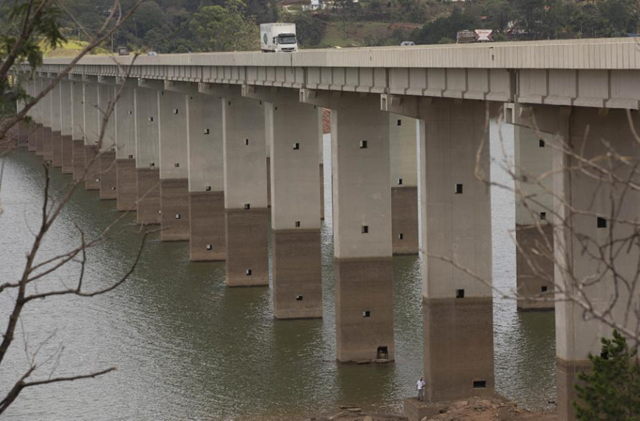
In this 29 January 2015 file photo, a bridge's columns are marked by the previous water line over the Atibainha reservoir, part of the Cantareira System that provides water to the Sao Paulo metropolitan area, in Nazare Paulista, Brazil. In 2015, Brazil's biggest city recorded its rainiest March since 2008, but the worst drought in more than 80 years has left reservoir levels critically low, and water experts fear that strict water rationing may still loom for Sao Paulo as it enters the April-September dry season. Photo: Andre Penner / AP Photo


By Stan Lehman 
2 April 2015
SÃO PAULO (Associated Press) – Brazil's biggest city has recorded its rainiest March since 2008, but the worst drought in more than 80 years has left reservoir levels critically low and water experts fear that strict water rationing may still loom for São Paulo as it enters the April-September dry season.
The crucial Cantareira water system, which provides water to about 6 million of the 20 million in the metropolitan area, was still only about one-fifth full as the dry season began.
Authorities already have imposed water-saving measures, including cut rates for people who limit usage, reduced pressure in water lines during off-peak hours and de facto rationing: some areas receive water only half the day.
Environment Minister Izabella Teixeira said this week that those programs must be expanded, and the government is preparing "a rational water-use program, given the end of the rainy season." She offered no details.
But some think that may not be enough.
Mario Thadeu Leme de Barros, head of the University of São Paulo's hydraulic engineering and environmental department, said existing measures, combined with the transfer of water among reservoirs, "will hopefully allow us to reach the end of the year with the mini-rationing that exists."
He also called for the use of more efficient appliances, the use of wastewater and better detection of leaks in a system that loses more than 30 percent of its water to leaks.
"But we cannot discard the possibility of more harsh water rationing measures should we be hit with an even worse drought during the coming dry season," he said.
Moody's Investors Service warned last month that water rationing looks increasingly likely, adding, "Overall, mandatory federal or state water rationing would worsen Brazil's already sluggish economic growth."
In March, São Paulo, received 8.13 inches (206.5 millimeters) of rain, 16 percent above the average, boosting the level of the Cantareira system from 5 percent to nearly 19 percent of its capacity, the water utility Sabesp said Thursday on its website.
The other five systems were at 23 percent to 97 percent of capacity as the dry season started.

Time For A New Rain Dance


Tuesday, October 8, 2013

Food Shortages Now Rock #Venezuela

Food Shortages
Now Rock Venezuela
(PanAm Post Article)


Venezuela Reinforces Shortage Controls: Attorney General Threatens Punishment for "Hoarding"
Read More


Is It Exponential Math Yet?


Now what does Venezuela have in common with Syria, Egypt, Greece, Italy, Cyprus, Portugal  and a host of many others? Start with rapid population growth, and then add in a sharp decline in natural resources critical to generating export revenues needed to buy food stock for its growing number of mouths. The Flat J Curves that we observe globally are infesting individual countries who had for decades followed the false prophets (sic) of classical economic theory. Wealth was not created, rather it disappeared. 

Now look at what happens when those naive make-believe positive-sum games collide with real physical economic constraints that refuse to negotiate and do not allow more blood, or as in this case; OIL - to be drawn from the stone. Food Shortages result, turning to social unrest which then sets the stage for political upheaval. Anyone starting to see a pattern emerging here yet? Clearly, not the gurus working at the IMF, World Bank, UN and other bastions of astute and thoughtful analysis. 

We are not going to forecast the future here, but all minds should begin to turn to the insightful destiny of Nauru, Easter Island and others to see the path that most likely lies ahead for these failing economies. Economists may continue to mutter eloquently with gibberish that suggests these nations need to conform and adhere more rigorously to their naive growth theories and monetary doctrines. They all tried that nonsense. So why can't they create the wealth and grow out of it?

Because there is so much less to grow with, and too many more to grow for. It is a pie that is shrinking while facing demands of a rapidly growing population. And as we know, that sort of silly mathematics only works at the Highly Esteemed  Schools of Classical Economists. Voodoo math that is totally ignored by the physical laws governing - Entropy!

To close, we fondly observe - SNAFU 


Dr Peter G Kinesa
October 7, 2013 


Sharply Declining Resources


Rapidly Growing Populations


Equals = Exponential?


Motivate, Inspire, Positive