WORLD LEADING INSIGHTS

International LEADERS Calling Market Crashes Years Ahead
Second to None, Anywhere...

'Warned 2000 tech slide; predicted 2008 meltdown in 2007. Forecasted 2020 global economic collapse in 2011, AND NOW- BY 2050 - THE MOTHER OF ALL CRASHES"

Featured Post

#TROUBLE AHEAD AS #ICE SHELF DEVASTATED IN #ANTARCTIC

 REUTERS Thinning Antarctic ice shelf finally crumbles after heatwave By  Isla Binnie March 25 (Reuters) - An East Antarctica ice shelf disi...

Inspire, Achieve, Success

Search This Blog

SAVE ON HOT STUFF

Showing posts with label #markets. collapse. Show all posts

Wednesday, April 15, 2015

Everyone You Know Going NUTS? Here's' WHY?

Before Civilization Collapses, It Will Go Stark-Raving MAD!

“Whom the gods would destroy, they first make mad.” – by Prometheus, in the Masque of Pandora (1875) by Henry Wadsworth Longfellow

Mad World


April 2015 – CIVILIZATION – The enormous cognitive dissonance between our growing awareness of our civilization’s accelerating collapse, and the ‘news’ in the media and the subjects of most public discourse, continues to baffle me. Though I suspect it shouldn’t. We are all slow learners, preoccupied with the needs of the moment, with a preference for reassurance over truth. I often find myself, these days, at social and other events, at a loss for words, not saying anything, as a result. It’s as if I speak an utterly different language from the people I meet in my day-to-day life, so what’s the point of saying anything? Perhaps this is Gaia’s way of teaching me patience. I continue to vacillate back and forth all the way from the humanist worldview (F. on the ‘map’ above’) to the near-term extinctionist worldview (L.), depending on what I’m doing and who I’m doing it with, or what I’m reading (Charles Eisenstein seems to best represent worldview F. and Guy McPherson best articulates worldview L., and I greatly admire them both). 


I’m happy with company anywhere along that continuum — they both speak my newly-acquired language, though with very different dialects. It’s sad to me that most people find collapse too terrifying to contemplate. I find it liberating. Read More.

Remember Nobody Can Just Fly Over The Cuckoo's Nest???

Tuesday, April 7, 2015

Worst Drought Ever Alters #Yosemite National Park

Drought Alters Familiar Landscape In Yosemite National Park

"Where's the waterfall?"

Hikers walk along the muddy banks of Mirror Lake on March 19, 2015 in Yosemite National Park, Calif. Tenaya Creek feeds Mirror Lake, whose banks have receded months earlier than usual, the remaining water reflects bare rock that is usually covered in snow this time of year. (Robert Gauthier/Los Angeles Times/TNS)

YOSEMITE NATIONAL PARK — Yosemite National Park is bracing for its driest year on record, with visitor bureaus downplaying the allure of the park's most famous waterfall and instead touting the park as a destination for hiking, bicycling and photography.Yosemite Falls will probably go dry in June — two months earlier than usual, parks officials say. The Merced River, which powers the spectacular Nevada and Vernal falls before meandering across the Yosemite Valley floor, will probably slow to a shallow stream about the same time.
And with the drought enabling western pine bark beetles to kill large areas of forest, the park is preparing for a bad fire season."Visitors bureaus are saying they're not going to promote Yosemite Falls as much this year," said Scott Gediman, assistant superintendent for public and legislative affairs at the park. "My response: No problem. We have to be realistic." Read more

The Wrong Kind of Changes?


Friday, May 23, 2014

#CLIMATE Catastrophe Strikes #Bosnia and #Serbia

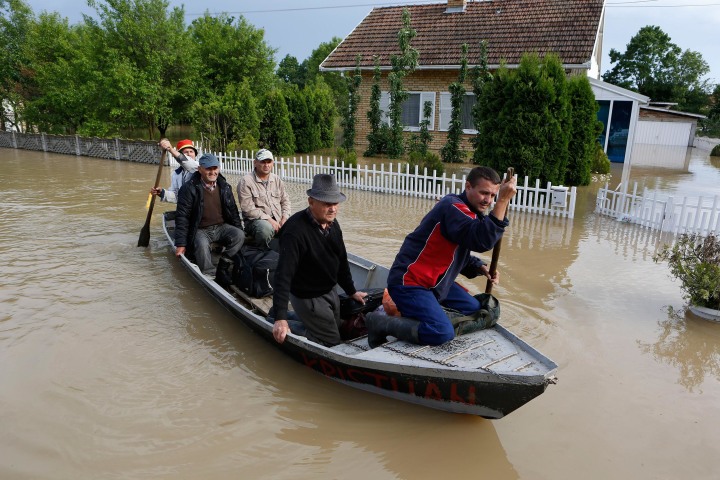
Image: Bosnian people are rescued from their flooded houses by boat

Serbia and Bosnia Flooding Disturbs Land Mines From Region's 1990s War


18 May 2014 (Associated Press) – Floodwaters triggered more than 3,000 landslides across the Balkans on Sunday, laying waste to entire towns and villages and disturbing land mines leftover from the region's 1990s war, along with warning signs that marked the unexploded weapons.
The Balkans' worst flooding since record keeping began forced tens of thousands of people from their homes and threatened to inundate Serbia's main power plant, which supplies electricity to a third of the country and most of the capital, Belgrade.

Aerial view of homes sitting submerged due to overflowing rivers in Doboj, a northern city of Bosnia and Herzegovina on 16 May 2014. Photo: Kemal Zorlak / Anadolu / Getty Images
Authorities organized a frenzied helicopter airlift to get terrified families to safety before the water swallowed up their homes. Many were plucked from rooftops.
Floodwaters receded Sunday in some locations, laying bare the full scale of the damage. Elsewhere, emergency management officials warned that the water would keep rising into Sunday night. 

"The situation is catastrophic," said Bosnia's refugee minister, Adil Osmanovic. 

Three months' worth of rain fell on the region in three days, producing the worst floods since rainfall measurements began 120 years ago. At least two dozen people have died, with more casualties expected. 

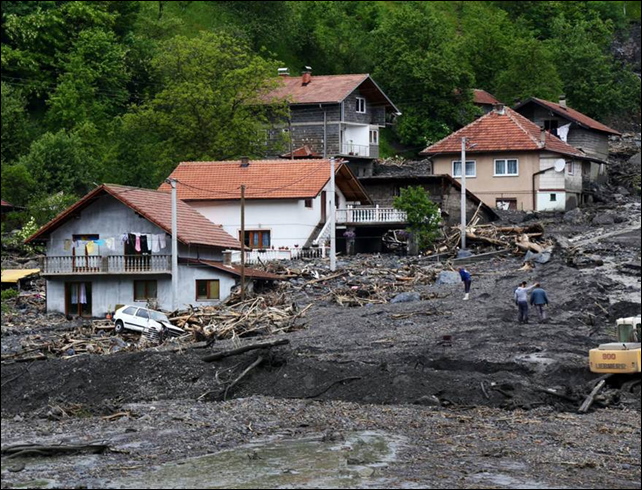
Houses sit damaged from record-breaking rains in Sarajevo, Bosnia, and Herzegovina on 17 May 2014. Throughout hilly Bosnia, floods triggered landslides covering roads, homes, and whole villages. Photo: Ismail Duru / Anadolu / Getty Images
The rain caused an estimated 2,100 landslides that covered roads, homes and whole villages throughout hilly Bosnia. Another 1,000 landslides were reported in neighboring Serbia. 


Read More 


Power Plants Also Threatened


Doc's Comments

This is a disaster of unmeasured proportions - again, we are seeing the climate chaos being caused by global warming leaving no region on the planet untouched. Where are our leaders? Hmm...

Dr Peter G Kinesa
May 23,2014

Wednesday, May 14, 2014

Top Insurer's Chairman Confirms Climate Risks - #Lloyds of London

Insurers must adapt to climate change


New York


By John Nelson, 
Chairman of Lloyd's of London

(theguardian.com) – There is no doubt the climate is changing. Each of the past three decades has been warmer than the previous one, and the vast majority of scientific evidence points to this being caused by mankind's reliance on carbon-based fossil fuels.

While understanding weather patterns and the risks associated with major weather events has always been critical to the insurance industry, climate change has recently brought the need for better modelling of future weather into sharp focus.


According to the World Bank, weather-related losses and damage have risen from an annual average of about $50bn in the 1980s to close to $200bn. Lloyd's knows this all too well, the damage wrought on the US by the hurricanes Katrina, Rita, and Wilma in 2005 and Superstorm Sandy in 2012 to name but a few all brought significant claims to the insurance market. 

Many types of business we insure are affected by climate change. There are the obvious ones such as property, catastrophe and crop insurance. But Superstorm Sandy taught us that the reach of extreme weather is far greater than that. The destruction Sandy brought to the eastern US seaboard was responsible for claims of up to $300m in lost fine art, a consequence of the many expensive US beachfront homes damaged. Modelling has shown that the approximate 20cm of sea-level rise at the southern tip of Manhattan Island increased Sandy's surge losses by 30% in New York alone. 

The aftermath of Hurricane Katrina in New Orleans in 2005. 'Ultimately, insurance exists to pick up the pieces and pay the claims when the likes of a Hurricane Katrina or a Superstorm Sandy strike.' Photo: Larry W Smith / EPA
As a response, our recent Catastrophe Modelling and Climate Change report calls for the insurance industry to take seriously the impact of climate change and the implications it poses for the industry. The first step has to be making sure that catastrophe models can properly account


Read More


Wednesday, April 16, 2014

FOOD PRICE SHOCKS - More to Come?

Comments:

The under noted and somewhat quiet indices, are by far the most important global investment metrics to those learned and sharp minds that need a sound reading on the pulse of human activity . They are not given the attention they deserve, but without a doubt they weight ahead of the conventional Dow, CPI, GDP and all the rest, oft over used by retail media. In so many ways, they provide a comprehensive measure of the global state of affairs, in physical and economic terms.

If they are not part of and near the top of your metrics portfolio, you are bound to have considerable trouble with investment returns and economic decisions in the years ahead. If we have to explain why - then, it is strongly suggested that you are better suited for other fields and endeavours. 


Dr Peter G Kinesa

April 16, 2014


FAO Food Price Index rose sharply for a second consecutive month
3 April 2014 (FAO) – The FAO Food Price Index is a measure of the monthly change in international prices of a basket of food commodities. It consists of the average of five commodity group price indices, weighted with the average export shares of each of the groups for 2002-2004.

The FAO Monthly Food Price Indices, January 1990 - March 2014. Data are from www.fao.org. Graphic: Jim Galasyn» The FAO Food Price Index averaged 212.8 points in March 2014, up 4.8 points, or 2.3 percent, from February and the highest level since May 2013. Last month’s increase was largely driven by unfavourable weather conditions affecting some crops and geopolitical tensions in the Black Sea region. Overall, except for the FAO Dairy Price Index, which fell for the first time in four months, all the other commodity price indices registered gains, with sugar and cereals increasing the most.

» The FAO Cereal Price Index averaged 205.8 points in March, up as much as 10 points, or 5.2 percent, from February, marking the second month of significant increases. While in March the Index rose to its highest value since August 2013, it remained well below (34.6 points or 14.4 percent) its value in March 2013. Last month’s strength stemmed from a surge in wheat and maize prices reflecting a strong pace in grain imports, growing concerns over the effect of continued dryness in the south-central United States on winter wheat crops, and unfavourable weather in parts of Brazil. Geopolitical tensions in the Black Sea region, in particular uncertainties with regard to grain shipments from Ukraine, also provided a boost.  Rice prices were generally stable.


» The FAO Vegetable Oil Price Index averaged 204.8 points in March, up another 7 points (or 4.5 percent) from February and the highest level in 18 months. The rise in the index mainly reflected a surge in palm oil, on continued concerns over the impact of protracted dry weather in Southeast Asia. Tight inventories in Malaysia and the prospect of rising domestic consumption in Indonesia, the top palm oil producer and exporter, contributed to the strengthening in palm oil values, as did reports about a possible El Niño weather event later this year. International prices for soy, sunflower and rape seed oil also firmed.
» The FAO Dairy Price Index averaged 268.5 points in March, a fall of 6.9 points, or 2.5 percent, over February. Demand for all dairy products has been affected by reduced purchases by China and uncertainty over trade with the Russian Federation.  Additionally, an extended season in New Zealand and a good start to the dairy-year in the northern-hemisphere have meant that supplies for export have increased.  The dairy commodity subject to the sharpest price drop was Whole Milk Powder, reflecting reduced buying interest from China, in particular.

» The FAO Meat Price Index averaged 185 points in March, 2.7 points, or 1.5 percent, above February.  The main driver was higher bovine meat prices, which were associated with dry weather conditions affecting production in both Australia and the United States. Prices for pigmeat also rose, in part on concerns over the effect of Porcine Epidemic Diarrhea virus on export supplies in the United States.  Prices of poultry and ovine meat were only slightly stronger.

» The FAO Sugar Price Index averaged 253.9 points in March, up 18.5 points, or 7.9 percent, from February.  Sugar prices kept strengthening amid concerns of declining export availabilities from Brazil and Thailand, due to drought and reduced sugarcane output, respectively. The likelihood of sugar crops being adversely affected by El Niño later this year also contributed to the price surge.


Friday, October 18, 2013

Five Billion People Face Water Scarcity


Threshold level of ΔTg leading to significant local changes in water resources (a) and terrestrial ecosystems (b). (a) Coloured areas: river basins with new water scarcity or aggravation of existing scarcity (cases (1) and (2), see section 2.3.1); greyish areas: basins experiencing lower water availability but remaining above scarcity levels (case (3)); black areas: basins remaining water-scarce but without significant aggravation of scarcity even at ΔTg = 5 °C (case (4)). No population change is assumed here. Basins with an average runoff <10 mm yr−1 per grid cell are masked out. (b) Regions with severe (coloured) or moderate (greyish) ecosystem transformation; delineation refers to the 90 biogeographic regions. All values denote changes found in >50% of the simulations. Graphic: Gerten, et al., 2013

Water Scarcity

Five Billion At Risk

By the end of this century with concurrent trending in population growth it is projected that up to five billion people could be exposed towater scarcity. These figures are according to a recent scientific research letter published in IPOScience  (read more  above).  Here’s the real scary part – that assumes that temperature does not rise 1.5 to 2 degrees Celsius over pre-industrial levels. Guess what? We are trending to go higher because restrictive measures are not being implemented.  The number should be bigger!

The report referenced provides ample numerical, mathematical and modeling analysis if you have a geeky urge.  What cannot be emphasized enough is that we are not just talking about ducks and daisies here – we are talking about the essence of human life. Climate change is not a bad dream to be swept under the media carpet, and ignoring it may not affect our lives, but the misery we are leaving our children, grand children and so on, has never been imagined by any word constructions of any dictionary on the planet.

Now, I leave you with no further words - just that thought…  

Dr Peter G Kinesa
October 17,2013
Popular Museum Attraction - 2133 AD 


Saturday, October 12, 2013

Japan's PM Sends #Fukushima SOS


Japan's PM Sends
Fukushima SOS

My country needs your knowledge and expertise”

(Al Jazeera America)
Read More Here


Almost daily the reactor at Fukushima faces new leaks of radioactive water as tanks overflow and spill their refuse into nearby seas. Over a month ago Japan had stated to the 2020 Olympic Committee, that the situation was under control. Not so, as reflected by their Prime Minister's recent call for international assistance. Japan's problems are also flowing over into the nuclear industry, that just had two multi-billion dollar projects more or less cancelled in a Canadian province.

It seems that the media is also playing down the consequences on the local fishing industry because local Sushi restaurants are in a business as usual mode. At this point it is hard to determine what the final outcomes will be until the situation is put to rest and some time has lapsed to allow for a damage assessment. There is little doubt its affects are far-reaching and may still have an impact on the larger economy as energy costs are certain to rise over time. 

Crippling the world's third largest economy is sure to have spreading global effects that may ultimately cause havoc in the global financial markets too. Therefore, it is self-evident why such a hush-hush environment exists around disclosure, events and media.

Meaning that we are going to continue monitoring developments as they are reported. Events here could dramatically change too many things, particularly when there is little evidence that they are contained or may even becoming worse?

Dr Peter G Kinesa
October 12, 2013  

Tuesday, October 8, 2013

Food Shortages Now Rock #Venezuela

Food Shortages
Now Rock Venezuela
(PanAm Post Article)


Venezuela Reinforces Shortage Controls: Attorney General Threatens Punishment for "Hoarding"
Read More


Is It Exponential Math Yet?


Now what does Venezuela have in common with Syria, Egypt, Greece, Italy, Cyprus, Portugal  and a host of many others? Start with rapid population growth, and then add in a sharp decline in natural resources critical to generating export revenues needed to buy food stock for its growing number of mouths. The Flat J Curves that we observe globally are infesting individual countries who had for decades followed the false prophets (sic) of classical economic theory. Wealth was not created, rather it disappeared. 

Now look at what happens when those naive make-believe positive-sum games collide with real physical economic constraints that refuse to negotiate and do not allow more blood, or as in this case; OIL - to be drawn from the stone. Food Shortages result, turning to social unrest which then sets the stage for political upheaval. Anyone starting to see a pattern emerging here yet? Clearly, not the gurus working at the IMF, World Bank, UN and other bastions of astute and thoughtful analysis. 

We are not going to forecast the future here, but all minds should begin to turn to the insightful destiny of Nauru, Easter Island and others to see the path that most likely lies ahead for these failing economies. Economists may continue to mutter eloquently with gibberish that suggests these nations need to conform and adhere more rigorously to their naive growth theories and monetary doctrines. They all tried that nonsense. So why can't they create the wealth and grow out of it?

Because there is so much less to grow with, and too many more to grow for. It is a pie that is shrinking while facing demands of a rapidly growing population. And as we know, that sort of silly mathematics only works at the Highly Esteemed  Schools of Classical Economists. Voodoo math that is totally ignored by the physical laws governing - Entropy!

To close, we fondly observe - SNAFU 


Dr Peter G Kinesa
October 7, 2013 


Sharply Declining Resources


Rapidly Growing Populations


Equals = Exponential?


Thursday, September 12, 2013

#BBC News - Climate Change Pictures

(Read More)

Woolly Mammoth

We Remember These Guys?

As they say, pictures can be worth a thousand words. So I will let them do the talking.

Dr Peter G Kinesa
September 12, 2013  


Who will remember?

TOP ECONOMIC GRAPH - USGS GROUNDWATER : There is No Fracking Water?


Annual groundwater withdrawal estimates by water-use class from the Death Valley regional flow system, 1913 through 1998. Graphic: USGS / San Juan et al., 2010

Imagine down the road one generation is going to have to decide between whether to use and spoil groundwater for fracking oil or irrigation and farming purposes, and thus food supply. Groundwater is a key ingredient in both processes. And looking at the above graph it is apparent that the amount being used for non-agricultural reasons has been rising over the past four decades, according to this USGS report. The full report is linked above for your study.

The other obvious concern that the chart brings out; how much groundwater is there? As the population and various commercial needs grow when does demand outstrip possible supply? Right now, we do not have or see any clear answers to these questions, but hopefully someone does have them before we reach that point. Then, of course, who will decide whether you eat or drive? Hmm...

So whether it's the extinction of pollinating bugs or the exhaustion of groundwater, it looks like farming is about to become much less productive in the years ahead, despite the growing number of mouths it will be expected to feed. And that's not even taking into account what effects may come from climate change - starting with less rainfall. 

One might add - so what's all the fracking excitement about?

Dr Peter G Kinesa
September 12, 2013 


You Decide!

Motivate, Inspire, Positive