WORLD LEADING INSIGHTS

International LEADERS Calling Market Crashes Years Ahead
Second to None, Anywhere...

'Warned 2000 tech slide; predicted 2008 meltdown in 2007. Forecasted 2020 global economic collapse in 2011, AND NOW- BY 2050 - THE MOTHER OF ALL CRASHES"

Featured Post

#TROUBLE AHEAD AS #ICE SHELF DEVASTATED IN #ANTARCTIC

 REUTERS Thinning Antarctic ice shelf finally crumbles after heatwave By  Isla Binnie March 25 (Reuters) - An East Antarctica ice shelf disi...

Inspire, Achieve, Success

Search This Blog

SAVE ON HOT STUFF

Showing posts with label #decline #madmax. Show all posts

Friday, April 17, 2015

WATER CRISIS #BRAZIL - A Ghost of #Christmas Future?


Water crisis: 56 Northeastern cities 

are in situation of collapse, says 

Government


BRASILIA — in yet another Government meeting to evaluate the water crisis in part of the country, the diagnosis is that, in the Northeast, there are currently 56 cities in State of collapse, i.e. for more than four days without water.


Will IT Happen Here?


 According to the Government, there is an ongoing kite cars operation being managed by State and local governments. In the Southeast, despite the March rains, the water regime was lower than expected and the reservoirs of Rio de Janeiro and Sao Paulo are still operating below the average. Read More


Dicken's Scrooge Also Climate Allegory?


Monday, April 13, 2015

Are #Oceans Buffering Climate Shocks? For How Long?


How Long Can Oceans Continue To Absorb Earth's Excess Heat?


The main reason soaring greenhouse gas emissions have not caused air temperatures to rise more rapidly is that oceans have soaked up much of the heat. But new evidence suggests the oceans’ heat-buffering ability may be weakening.

by cheryl katz


For decades, the earth’s oceans have soaked up more than nine-tenths of the atmosphere’s excess heat trapped by greenhouse gas emissions. By stowing that extra energy in their depths, oceans have spared the planet from feeling the full effects of humanity’s carbon overindulgence. Read More 


Those Warmer Waters Affect Fish And...?


cheryl katzABOUT THE AUTHOR
Cheryl Katz is a San Francisco Bay Area-based science writer covering energy, environmental health, and climate change. She has reported from Iceland to Africa on issues ranging from geothermal power to flood control. Her articles have appeared in Scientific American, National Geographic.com, and Science News. Previously for e360, she reported on promising new solar energy technologies and challenges inforecasting extreme weather.

MORE BY THIS AUTHOR

Saturday, April 11, 2015

#McKinsey & Co Implies Mother Nature Asks #Humanity To Reschedule Global Debt

McKinsey & Co - Debt And (Not Much) Deleveraging 


Global debt growth, 2000-2014. Global debt has increased by $57 trillion since 2007. China's debt has quadrupled. Graph: McKinsey Global Institute


Seven years after the bursting of a global credit bubble resulted in the worst financial crisis since the Great Depression, debt continues to grow. In fact, rather than reducing indebtedness, or deleveraging, all major economies today have higher levels of borrowing relative to GDP than they did in 2007. Global debt in these years has grown by $57 trillion, raising the ratio of debt to GDP by 17 percentage points (Exhibit 1). That poses new risks to financial stability and may undermine global economic growth.


A new McKinsey Global Institute (MGI) report, Debt and (not much) deleveraging, examines the evolution of debt across 47 countries—22 advanced and 25 developing—and assesses the implications of higher leverage in the global economy and in specific sectors and countries. The analysis, which follows our July 2011 report Debt and deleveraging: The global credit bubble and its economic consequences and our January 2012 report Debt and deleveraging: Uneven progress on the path to growth, focuses on the debt of the “real economy”: governments, nonfinancial corporations, and households. It finds that debt-to-GDP ratios have risen in all 22 advanced economies in the sample, by more than 50 percentage points in many case. Read More.


Why Is Mother Nature Crying About Global Debt Expansion?


Image result for mother nature crying earth


Monday, April 6, 2015

#BBC #Mongolia Sludges Into Ecological Nightmare

The Dystopian Lake Filled By The World's Tech Lust


Hidden in an unknown corner of Inner Mongolia is a toxic, nightmarish lake created by our thirst for smartphones, consumer gadgets and green tech, discovers Tim Maughan. Black sludge pours into the lake - one of many pipes lining the shore. Photo: Liam Young / Unknown Fields

From where I'm standing, the city-sized Baogang Steel and Rare Earth complex dominates the horizon, its endless cooling towers and chimneys reaching up into grey, washed-out sky. Between it and me, stretching into the distance, lies an artificial lake filled with a black, barely-liquid, toxic sludge.
Dozens of pipes line the shore, churning out a torrent of thick, black, chemical waste from the refineries that surround the lake. The smell of sulphur and the roar of the pipes invades my senses. It feels like hell on Earth. Read More


"Rare Earth" 
Such An Ironic Twist of Words


Monday, November 18, 2013

Never go Home? - #Fukushima

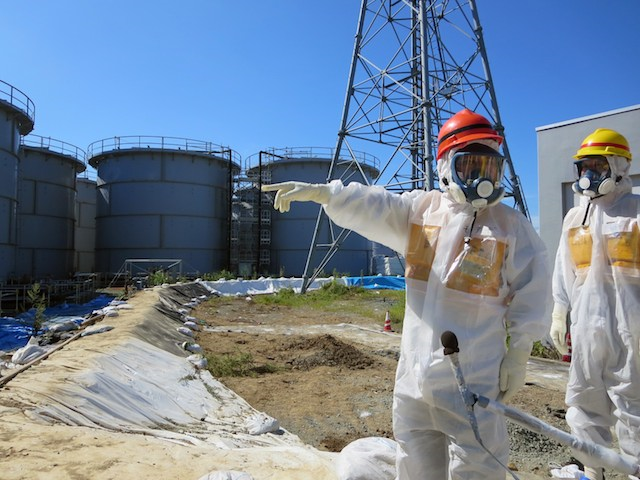
INSPECTING FUKUSHIMA. A handout picture provided by Tokyo Electric Power Co. (Tepco), shows Japanese Minister of Economy, Trade and Industry Toshimitsu Motegi (L) pointing to contaminated water storage tanks during his visit at the crippled Fukushima Daiichi Nuclear Power Plant in Okuma, northeast of Tokyo, Fukushima Prefecture, Japan, 26 August 2013. Photo: EPA / TEPCO / HANDOUT


The Guardian
Fukushima

Never Go Home?

 Read More Here


Could you imagine not being able to ever return home again for whatever reasons? Most of us would certainly be very upset and perturbed by such a situation. But that's exactly what the people who lived near the Fukushima nuclear plant are facing.

One leading Japanese Physicist remarked that had events spun out of control, then most of Northern Japan would have been uninhabitable. They are still not out of the woods yet, as there are many risks around the site that could trigger more disasters. Consequently there are many concerns that arise from this on-going situation that could also trigger a devastating financial crisis in Japan that would ripple through-out the world. Moreover, should Japan make a effort to rebuild from all this, then you can expect sharp increases in global interest rates to emerge.

Call it the Fukshima Financial Contagion - but that may be just the wake-up call we need to realize how fragile the overall energy situation is becoming. 

Dr Peter G Kinesa
November 18,2013


Home Sweet Home


Wednesday, October 23, 2013

#Fukushima Radiation - WHO's At Risk?


Fukushima
Radiation
Hitting the West Coast-
Who’s At Risk?
Read and View Video

This is not the time to get overly frightened and upset, nor is it the time to bury our heads in the sand and either hope or rationalize the dangers away. This above linked article provides anecdotal evidence with links to a variety of other stories, reporting the specific harms being done to the environment on the West Coast, possibly from the radioactive water of Fukushima. Is it possible that a distinct concentrated ocean current of this water had or could form causing such damage? - Yes, according to some scientific sources. 

Unfortunately, we cannot verify these scientific findings, conclusions and predictions one way or the other. That is one reason why we believe greater effort is needed from the world community.Moreover, the information that is coming out of Japan over the past two years has been inconsistent, contradictory and at times thought to be misleading. Contrast the effort here, to the eagerness and hyperbole surrounding efforts  to bomb Syria over its chemical weapons - and that was not even remotely threatening to North American shores. 

Again, we are not going to judge whether the risk is great or being overblown by media vigilantes, but what we do know is that this nuclear disaster has still not been contained after two years. There are indications too, that the spillage is getting worse. The Japanese Prime Minister has recently called out for global assistance. No one seems to know when this disaster is going to be fixed.These are all not adding up to a positive position for the world's third largest economy - as there are additional dangers of a major catastrophic financial fall-out spinning out of any escalated and protracted events. That would be a global event! . 

There are many known unknowns in play here, but here's the big unknown, unknown that should really concern the world.

What if there is another tsunami?  

To be quite frank, that or similar events, at this fragile point of time, is the biggest concern. We need, with the greatest urgency, to bring this  situation under control....

NOW!


Dr Peter G Kinesa
October 23, 2013


Risks of Fragile Times


Friday, October 11, 2013

#America Shrinking Brains?


America Shrinking Brains?
Score Below Average On Global Tests
(Associated Press)

American adults score poorly on global test
Read More


This should come as no surprise to anyone that the intellectual levels in the United States have been drifting lower over the past couple of decades. In fact. this trend plays havoc with demographers and media types who are constantly dumbing-down their programs and content in order to adjust to the lower common denominator. Why the shrinkage in brainpower? Numerous reasons exist; ranging from I and X toys, immigration demographics, costly elitist education, drug use, celebrity culture and poor diets, just to name a few. And in the long-run this trend will have serious economic, political, social and military implications. It is a National Security risk and huge economic disadvantage that cannot be fixed in a few years.

Beyond the tests.scoring and reported reasons maybe the deeper cause lies in the shrinkage of American leadership - the pictures captioned below tell a tale of a nation lacking in the quality of character, skills, knowledge and capabilities that its people deserve and who would act as role models for its future generations.

Dr Peter G Kinesa
October 11, 2013

Or Shrinking Leadership?  


Thursday, September 5, 2013

#California Smoke Gets in Your Eyes


Smoke from the Rim Fire

NASA Satellite View

Earlier we posted an important climate economic graph reflecting the upward shift in temperatures in six California regions - 1950 to 2010. If there are any doubters out there who think that a warmer climate is not causing displacements and health hazards to human conditions then they are certainly missing the tides of what may come. Major wildfires such as Yosemite pose not only health and living hazards, but the economic costs associated with containment and prevention may become overwhelming for a State already struggling with its finances.

And the wildfire damage also leads to further erosion in the quality of top soil. This means when the rains do come the coastal mountains respond by covering the scenic PCH with tons of fallen earth. Again giving rise to more costs to be born as the  sequential consequences of a warming climate   

Furthermore, fears of fire triggered by the smallest ember could lead to stricter regulations on campfires, barbecues, fireworks and maybe even smoking of any sort.These regulations would also affect other industries, commerce and tourism. At this point, no one knows what to anticipate as the climate's rising temperatures makes many areas much dryer. 

For sure, if conditions persist, the State will not be able escape deep economic consequences in the years ahead. Adding another concern to our list of non-financial metrics.

Dr Peter G Kinesa
September 5, 2013


  "On a dark desert highway, cool wind in my hair
Warm smell of colitas, rising up through the air..
 Welcome to..."
Eagles, Lyrics Hotel California


Tuesday, September 3, 2013

Top Economic Graph "CALIFORNIA STEAMING"

(Read More)

Summertime (June-August) maximum (Tmax) and minimum (Tmin) temperatures have increased between 1950 and 2010 for each of California's six climate regions. Graphic: CalEPA / OEHHA 

Here again we can look at key non-financial metrics that dig deeper into the wealth of an economy. California is already plagued by financial woes as budgetary deficits have brought the state to the brink many times. It is dancing on thin ice and requires the environment and climate to co-operate, if there is any hope of repairing fiscal issues. Not likely, as these climate graphs indicate.

Since 1950, the min and max temperatures have been increasing in all six regions in the state. Warmer temperatures means more wildfires as well as poorer growing conditions for agriculture, a major export from the state. This also means the supply of water will become more critical to serve both local fire-fighting and agricultural needs. This can only mean higher costs that will get passed on to food production; in turn consumers.

So, with this in mind we should keep a focused eye on the number and size of wildfires given their far-reaching economic implications within and outside the state. Hopefully, the Santa Ana winds don't make surfers and surfing also a past-time similar to those of California sun-bathers from millions of years ago.

Or, I wish they ought to be... 

Dr Peter G Kinesa
September 4, 2013


Land of the Endless Summer?


Motivate, Inspire, Positive