WORLD LEADING INSIGHTS

International LEADERS Calling Market Crashes Years Ahead
Second to None, Anywhere...

'Warned 2000 tech slide; predicted 2008 meltdown in 2007. Forecasted 2020 global economic collapse in 2011, AND NOW- BY 2050 - THE MOTHER OF ALL CRASHES"

Featured Post

#TROUBLE AHEAD AS #ICE SHELF DEVASTATED IN #ANTARCTIC

 REUTERS Thinning Antarctic ice shelf finally crumbles after heatwave By  Isla Binnie March 25 (Reuters) - An East Antarctica ice shelf disi...

Inspire, Achieve, Success

Search This Blog

SAVE ON HOT STUFF

Showing posts with label biosphere. Show all posts

Monday, April 20, 2015

#Ocean Acidification Spells Extinction Backwards


Acidic Oceans

Implicated in Earth's Worst Mass 

EXTINCTION

WASHINGTON 

Commercial fishermen and other mariners form the words ''Acid Ocean'' during an event held to spread the message of saving the oceans from acidification caused by fossil fuel emissions, in Homer, Alaska, in this file photo taken on September 6, 2009. REUTERS/Lou Dematteis

(Reuters) - It is one of science's enduring mysteries: what caused the worst mass extinction in Earth's history. And, no, it is not the one that wiped out the dinosaurs.
Scientists said on Thursday that huge amounts of carbon dioxide spewed from colossal volcanic eruptions in Siberia may have turned the world's oceans dangerously acidic 252 million years ago, helping to drive a global environmental calamity that killed most land and sea creatures.


The researchers studied rocks in the United Arab Emirates that were on the seafloor at the time and contained a detailed record of the changing ocean conditions at the end of the Permian Period. Read More.

Earth's Mass Extinctions 
"NOT "
Extraordinary Events! 
Image result for the sixth extinction timelines

Thursday, April 16, 2015

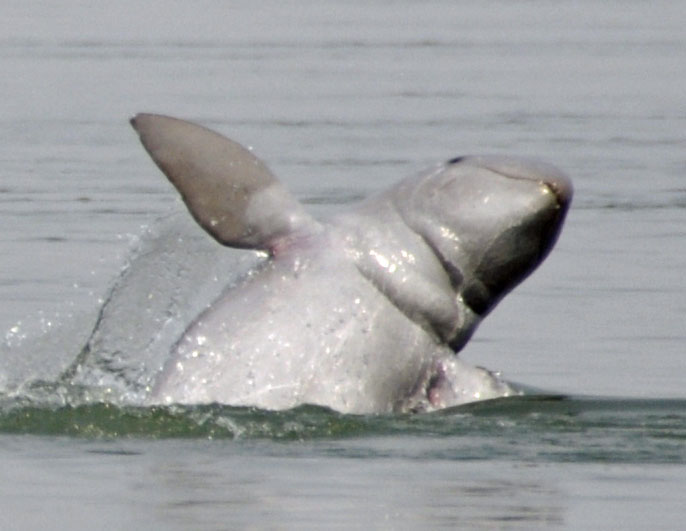
FIVE LEFT ON EARTH - Beautiful South Asian Dolphins

Dolphin's Death Leaves Only Five of Her Kind


The recent death of one of the remaining six Irrawaddy river dolphins in the Mekong River in Laos highlights the desperate situation for the already critically endangered animal.
Not the Only One, Too

Villagers in Cambodia discovered the female dolphin carcass on April 1, according to news reports in Phnom Penh. She was thought to have been one of the oldest and largest dolphins in the region — a trans-boundary river pool, called the Wang Paa Khaa, which straddles Laos and Cambodia; there are an estimated 85 dolphins remaining in all of the Mekong River, says WWF, of which Cambodia is home to the vast majority. Read More.
At Times There Are NO Words For Loss

Image result for final days oceans


Monday, April 13, 2015

Are #Oceans Buffering Climate Shocks? For How Long?


How Long Can Oceans Continue To Absorb Earth's Excess Heat?


The main reason soaring greenhouse gas emissions have not caused air temperatures to rise more rapidly is that oceans have soaked up much of the heat. But new evidence suggests the oceans’ heat-buffering ability may be weakening.

by cheryl katz


For decades, the earth’s oceans have soaked up more than nine-tenths of the atmosphere’s excess heat trapped by greenhouse gas emissions. By stowing that extra energy in their depths, oceans have spared the planet from feeling the full effects of humanity’s carbon overindulgence. Read More 


Those Warmer Waters Affect Fish And...?


cheryl katzABOUT THE AUTHOR
Cheryl Katz is a San Francisco Bay Area-based science writer covering energy, environmental health, and climate change. She has reported from Iceland to Africa on issues ranging from geothermal power to flood control. Her articles have appeared in Scientific American, National Geographic.com, and Science News. Previously for e360, she reported on promising new solar energy technologies and challenges inforecasting extreme weather.

MORE BY THIS AUTHOR

Saturday, April 11, 2015

#McKinsey & Co Implies Mother Nature Asks #Humanity To Reschedule Global Debt

McKinsey & Co - Debt And (Not Much) Deleveraging 


Global debt growth, 2000-2014. Global debt has increased by $57 trillion since 2007. China's debt has quadrupled. Graph: McKinsey Global Institute


Seven years after the bursting of a global credit bubble resulted in the worst financial crisis since the Great Depression, debt continues to grow. In fact, rather than reducing indebtedness, or deleveraging, all major economies today have higher levels of borrowing relative to GDP than they did in 2007. Global debt in these years has grown by $57 trillion, raising the ratio of debt to GDP by 17 percentage points (Exhibit 1). That poses new risks to financial stability and may undermine global economic growth.


A new McKinsey Global Institute (MGI) report, Debt and (not much) deleveraging, examines the evolution of debt across 47 countries—22 advanced and 25 developing—and assesses the implications of higher leverage in the global economy and in specific sectors and countries. The analysis, which follows our July 2011 report Debt and deleveraging: The global credit bubble and its economic consequences and our January 2012 report Debt and deleveraging: Uneven progress on the path to growth, focuses on the debt of the “real economy”: governments, nonfinancial corporations, and households. It finds that debt-to-GDP ratios have risen in all 22 advanced economies in the sample, by more than 50 percentage points in many case. Read More.


Why Is Mother Nature Crying About Global Debt Expansion?


Image result for mother nature crying earth


Monday, April 6, 2015

#BBC #Mongolia Sludges Into Ecological Nightmare

The Dystopian Lake Filled By The World's Tech Lust


Hidden in an unknown corner of Inner Mongolia is a toxic, nightmarish lake created by our thirst for smartphones, consumer gadgets and green tech, discovers Tim Maughan. Black sludge pours into the lake - one of many pipes lining the shore. Photo: Liam Young / Unknown Fields

From where I'm standing, the city-sized Baogang Steel and Rare Earth complex dominates the horizon, its endless cooling towers and chimneys reaching up into grey, washed-out sky. Between it and me, stretching into the distance, lies an artificial lake filled with a black, barely-liquid, toxic sludge.
Dozens of pipes line the shore, churning out a torrent of thick, black, chemical waste from the refineries that surround the lake. The smell of sulphur and the roar of the pipes invades my senses. It feels like hell on Earth. Read More


"Rare Earth" 
Such An Ironic Twist of Words


Monday, June 16, 2014

#Oregon Stars Are Dying - No More Twinkle, Twinkle...

Sea star disease epidemic surges in Oregon, local extinctions expected


 Contact: David Stauth, 541-737-0787; Kristen Milligan, 541-737-8862


CORVALLIS, Oregon (OSU) – Just in the past two weeks, the incidence of sea star wasting syndrome has exploded along the Oregon Coast and created an epidemic of historic magnitude, one that threatens to decimate the entire population of purple ochre sea stars.

Prior to this, Oregon had been the only part of the West Coast that had been largely spared this devastating disease.


A dying sea star. The leg of this purple ochre sea star in Oregon is disintegrating, as it dies from sea star wasting syndrome, 16 May 2014. Oregon had been the only part of the West Coast that had been largely spared this devastating disease. Photo: Elizabeth Cerny-Chipman / Oregon State University / flickr
The ochre sea star, which is the species most heavily affected by the disease in the intertidal zone, may be headed toward localized extinction in Oregon, according to researchers at Oregon State University who have been monitoring the outbreak. As a “keystone” predator, its loss could disrupt the entire marine intertidal ecosystem.

Researchers say this is the first time that die-offs of sea stars, more commonly known as starfish, have ever been identified at one time along such a wide expanse of the West Coast, and the sudden increase in Oregon has been extraordinary.
The best information is from the intertidal zone, which is easier to access for monitoring. In this area, less than 1 percent of the ochre sea stars in Oregon were affected in April, and only slightly more than that by mid-May.


Baffling Scientists?
Watch!


Today, an estimated 30-50 percent of the Oregon populations of this sea star species in the intertidal zone have the disease. The highest losses are at Fogarty Creek, where about 60 percent are affected. Researchers project that the epidemic will intensify and, at some sites, nearly 100 percent of the ochre sea stars could die.


Read More


"Say Dad, did you hear the news about Oregon?"
"Very sad, son"


Add caption

Thursday, June 12, 2014

Record Heat Bakes #Australia - #GOP Climate Experts say..."Uh!"

heatwaveAustralia experiences its hottest two years on record

High temperatures, which are forecast to continue through winter, are a clear sign of climate change, report warns

 heguardian.com,


Abnormal Autumn Warming in Australia. In May 2014, Australia experienced its hottest two years on record and high temperatures set to continue through winter in a clear sign of climate change, warned a report from the Climate Commission. Graphic: Climate Commission
Press) – Australia has experienced its hottest two years on record and high temperatures are set to continue through winter in a clear sign of climate change, a report warns.
May 2012 to April 2014 was the hottest 24-month period ever recorded in Australia, but that is likely to be eclipsed by the two years between June 2012 and May 2014, according to the Climate Commission's latest report, Abnormal Autumn.

"We have just had an abnormally warm autumn, off the back of another very hot 'angry summer'," Professor Will Steffen of the Climate Council said.

"The past two-year period has delivered the hottest average temperature we have ever recorded in Australia.

"Climate change is here, it's happening, and Australians are already feeling its impact."

The average temperature across Australia in April was 1.11C above the long-term average, the report says, citing Bureau of Meteorology figures.

The average minimum temperature was 1.31C above normal.

Unseasonable temperatures in the autumn "warm wave" set records, with Sydney, Adelaide, and Melbourne setting benchmarks for the consecutive number of May days when the mercury reached 20C or higher.

In its report, the Climate Council says the abnormally warm weather in April and May "are part of a longer-term trend towards hotter conditions in the summer months and more warm spells in autumn and winter"


Read More


Hottest Summer on Record!


Sunday, May 25, 2014

Humanity's Question: To be, Or not to be?

WHETHER IT IS NOBLER IN THE MIND?


(Special Report)


THAT IS THE QUESTION...


Today we are republishing a  commentary that was posted back in January 2013. The post is even more relevant today, as the critical issues we face as a species are escalating almost it seems beyond control. Reports are also being made by various LEGITIMATE groups including NASA, UN bodies and the White House and Pentagon. These reports are posted through-out our affiliated blogs and may be searched by keyword . Moreover, let's not forget too, that Stephen Hawkings sits on a committee that is actually planning "end of world events", while The Bank of England  is calling for a wholesale change in the dogmas of classical economics - as the stresses of infinite growth are self-evident in so many countries around the world. 

As a further result, the possibility that the EUJapan, China and other third world nations could financially collapse is a very real danger that could be sparked by an abrupt climb in global interest rates. Many events at any moment could spark this rapid rise, that would cause the greatest and most unprecedented collapse in asset values around the world where credit and banking bubbles in real estate and market investments, exist almost everywhere - another dark age looms large on the horizon.

Economics is not the only cancer that has terminal implications. Overpopulation and unbridled industrial destruction of the biosphere are crossing over to the exponential phase. Should the average global temperature rise just a mere 2 degrees C., some experts say we risk triggering a methane bomb that yields the same consequences of the Permian Extinction's climate conditions  - over 95%  of life on the planet was wiped out in short order.


Words of Science 


Wednesday, May 21, 2014

IT'S ALL OVER! #Nature is Dying

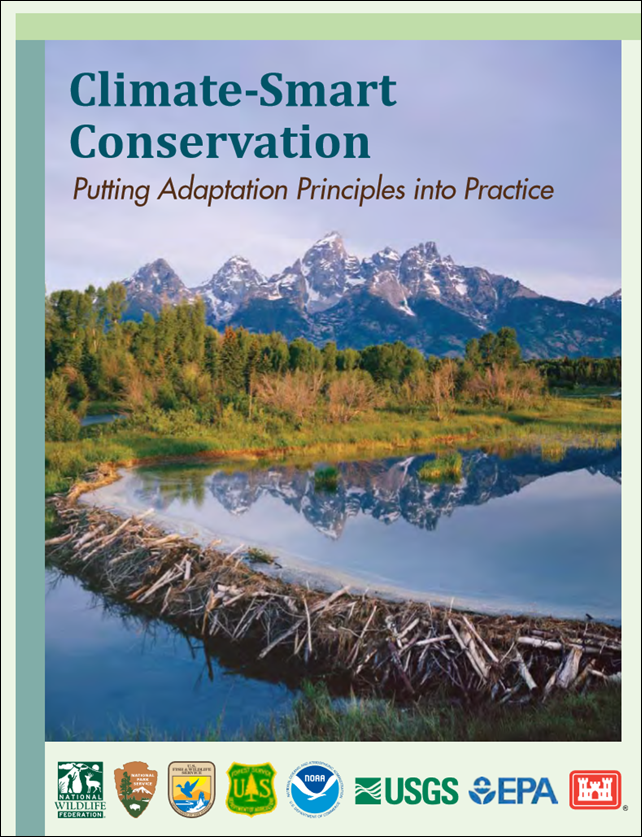
Cover of the National Wildlife Federation report, 'Climate-Smart Conservation', 2014. Photo: National Wildlife Federation

Impossible to Conserve Nature As Is, Thanks to Climate Change


A U.S. government-backed guide for land managers says global warming requires a fundamental shift in conservation


By Elizabeth Harball and ClimateWire


conservation
(Scientific American) – When President Theodore Roosevelt visited the Grand Canyon in 1903, he famously admonished the attending crowd to avoid meddling with the landscape. "Leave it as it is. You cannot improve on it," he said. 

True to Roosevelt's message, America's conservationists have since focused on maintaining the status quo, or at least restoring ecosystems to their natural state.

But due to the growing impacts of climate change, this can no longer continue, according to a new guide for land managers backed by multiple state and federal agencies.

"Addressing the growing threats brought about or accentuated by rapid climate change requires a fundamental shift in the practice of natural resource management in conservation," states the document, released yesterday by the National Wildlife Federation in partnership with the National Park Service, U.S. EPA, the National Oceanic and Atmospheric Administration, the U.S. Geological Survey and several other federal agencies and nongovernmental organizations.

"While managers traditionally have looked to the past for inspiration, increasingly we will be faced with future conditions that may have no historical analogs," it states.


The guide is intended to demystify climate adaptation for habitat and wildlife managers. It provides a step-by-step process evaluating how ecosystems may be vulnerable to climate change and how conservation goals might be altered for the best possible outcome.


‘No longer possible’ to maintain nature's status quo


Read More


And More Video


Motivate, Inspire, Positive