WORLD LEADING INSIGHTS

International LEADERS Calling Market Crashes Years Ahead
Second to None, Anywhere...

'Warned 2000 tech slide; predicted 2008 meltdown in 2007. Forecasted 2020 global economic collapse in 2011, AND NOW- BY 2050 - THE MOTHER OF ALL CRASHES"

Featured Post

#TROUBLE AHEAD AS #ICE SHELF DEVASTATED IN #ANTARCTIC

 REUTERS Thinning Antarctic ice shelf finally crumbles after heatwave By  Isla Binnie March 25 (Reuters) - An East Antarctica ice shelf disi...

Inspire, Achieve, Success

Search This Blog

SAVE ON HOT STUFF

Showing posts with label nuclear. Show all posts

Saturday, March 5, 2016

North Korea Planning Strike; Arming Missiles with Nukes

2016 Cuban Missile Crisis?

 This situation has not garnered the attention it deserves in the press nor by the markets. Should tensions escalate to the point of causing a nuclear event then such an engagement could lead to wider actions  bringing  the involvement of respective allies and the bigger powers. 

Even the limited use of nuclear weapons places the world in greater peril than most appreciate or know at first glance. Why? Russia operates a mechanized nuclear defence program that is often termed and referred to as  " the dead-hand system" because the missile-launch- order can  be triggered when its sensors determine that the radioactivity in the atmosphere is beyond preset acceptable levels. Breaching of these tests causes the system to conclude and assume that a nuclear attack is being carried out against their nation and it will then automatically order the launch of Russian missiles aimed at predetermined targets. 

There is no human involvement. 

 Originally the system was designed to provide for an immediate  retaliatory strike in the event that  the leadership in the Kremlin was destroyed 
by a first strike by an aggressor. 


and thus decapitating the decision-making powers ability to respond.  The premise of the system embraces the cold war  assumption  that the threat of mutual annihilation would deter  the superpowers, at the time, from ever entering into any confrontations using nuclear weapons.

However, today  this old and perhaps antiquated system could inadvertently  launch  missiles because the sensors detect the radiation from a much smaller nuclear conflict. Right now, as long as tensions remain high in North Korea there is a great danger that aggressions could expand rapidly into the global theatre. Such a possibility, to our knowledge has not been experienced since the Cuban Missile Crisis, in 1962, when the world was was gripped by fear and  just seconds away from a global nuclear war that could have wiped out all of humanity in mere days.

 In light of the concerns mentioned, and their potential consequences and devastation  - this situation is to be given the highest priority and attention in the days and weeks ahead. It is also noted that certain  US Presidential candidates indicated, in February, that they would approve a preemptive strike against North Korea - that does not sound like such a  good idea should it also lead to those same sensors detecting and acting upon excessive radioactivity in the atmosphere. Moreover, leadership in North Korea is far from stable or sensible - you have a child holding a loaded gun.      

In the last analysis, the world again is walking on eggshells; one misstep having frightening ramifications 


Free Logo From Thefreelogomakers.com

Will South Korea Have to Bomb the North, Eventually?


As North Korea expands its nuclear arsenal, will Seoul have to consider targeting missile sites at some point?

As North Korea continues to develop both nuclear weapons and the missile technology to carry them,pressure on South Korea to take preemptive military action will gradually rise. At some point, North Korea may have so many missiles and warheads that South Korea considers that capability to be an existential threat to its security. This is the greatest long-term risk to security and stability in Korea, arguably more destabilizing than a North Korean collapse. If North Korea does not arrest its nuclear and missile programs at a reasonably small, defensively-minded deterrent, then Southern elites will increasingly see those weapons as threats to Southern survival, not just tools of defense or gangsterish blackmail.

READ MORE


North Korean Leader Wants Nukes Ready to Fly


North Korean leader Kim Jong Un has ordered nuclear weapons to be readied for use, the state-controlled Korean Central News Agency reported Thursday.


AP JAPAN NORTH KOREAS NUKE THREAT I FILE PRK
 READ MORE

Australian democracy faces 'corrosive' decline 

Our rights must be strengthened after attacks on whistleblowers and press freedom, curbing peaceful protest, sidelining courts, limiting advocacy by community organisations and the government’s use of “financial levers” on advocacy groups to stifle criticism - all point to a decline in basic rights. 


Can Australian Catholicism Save Itself From Its Ultra-Conservative Forces? 

In attaching itself to power, Catholicism has become a lapel badge of the elite. But to appeal to its real constituents it needs to get back in touch with its core teachings.


Major trade deals are a serious threat to democracy and the environment

What the Commission calls barriers to trade are in fact the safeguards that keep toxic pesticides out of our food or dangerous pollutants out of the air we breathe. 


NO Surprise - Internet Making  People Dumber

No longer can we boast about 12 seconds of coherent thought

The average attention span for the notoriously ill-focused goldfish is nine seconds, but according to a new study from Microsoft Corp., people now generally lose concentration after eight seconds, highlighting the affects of an increasingly digitalized lifestyle on the brain.
Researchers in Canada surveyed 2,000 participants and studied the brain activity of 112 others using electroencephalograms (EEGs). Microsoft found that since the year 2000 (or about when the mobile revolution began) the average attention span dropped from 12 seconds to eight seconds 
READ MORE 


Monday, April 27, 2015

#Fukushima Story - Pacific Coast #Sardines Industry Faces Complete Collapse

Pacific Sardine Industry Shutdown Looms As Species Collapses


Image result for funny sardines pictures

Pacific coast sardines are facing a population collapse so severe that Oregon's multimillion-dollar sardine industry almost certainly will be shut down this summer.

Anticipating fishermen will pursue anchovies instead, ocean conservationists are pushing for pre-emptive measures to avoid repeating the collapse with another species.

The Pacific Fishery Management Council, which regulates the fishing industry off the coast of Oregon, California and Washington, is expected to vote Sunday to close the West Coast sardine fishery in response to new population estimates that indicate the species' still hasn't emerged from an eight-year plummet. The Oregonian - Read More.


More Nuclear Fukushima Pacific Coast Fish 


Wednesday, March 26, 2014

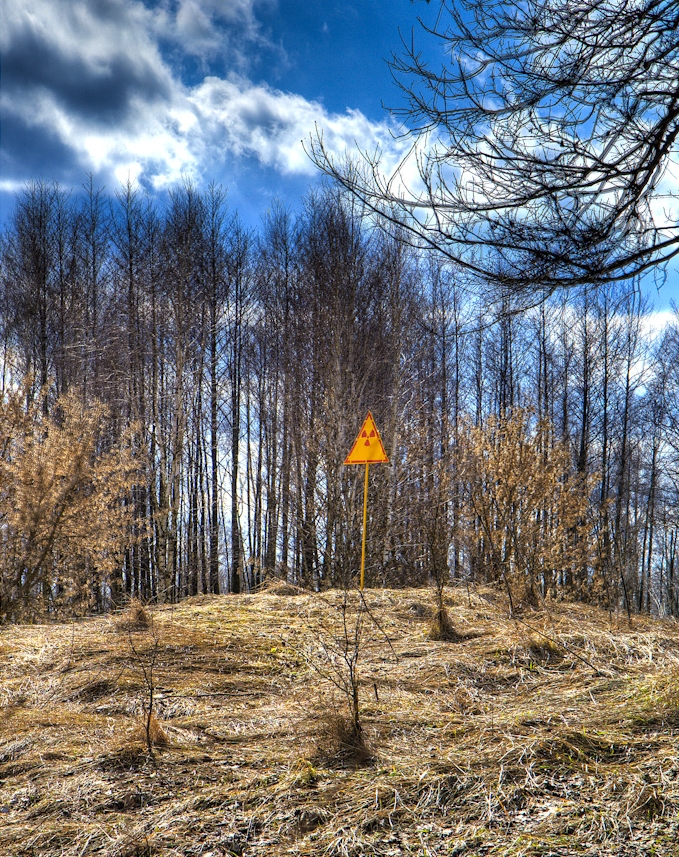
Nuclear Forests of Chernobyl

Forests Around Chernobyl Aren't Decaying Properly

Satellite Photograph

(Smithsonian Magazine) – Nearly 30 years have passed since the Chernobyl plant exploded and caused an unprecedented nuclear disaster. The effects of that catastrophe, however, are still felt today. Although no people live in the extensive exclusion zones around the epicenter, animals and plants still show signs of radiation poisoning.


Strange Small-Brained Bird

Birds around Chernobyl have significantly smaller brains that those living in non-radiation poisoned areas; trees there grow slower; and fewer spiders and insects—including bees, butterflies and grasshoppers—live there. Additionally, game animals such as wild boar caught outside of the exclusion zone—including some bagged as far away as Germany—continue to show abnormal and dangerous levels of radiation. 

However, there are even more fundamental issues going on in the environment. According to a new study published in Oecologia, decomposers—organisms such as microbes, fungi and some types of insects that drive the process of decay—have also suffered from the contamination. These creatures are responsible for an essential component of any ecosystem: recycling organic matter back into the soil. Issues with such a basic-level process, the authors of the study think, could have compounding effects for the entire ecosystem.


Glowing Forests
The team decided to investigate this question in part because of a peculiar field observation. “We have conducted research in Chernobyl since 1991 and have noticed a significant accumulation of litter over time,” the write. Moreover, trees in the infamous Red Forest—an area where all of the pine trees turned a reddish color and then died shortly after the accident—did not seem to be decaying, even 15 to 20 years after the meltdown.

(Read More)

Monday, November 18, 2013

Never go Home? - #Fukushima

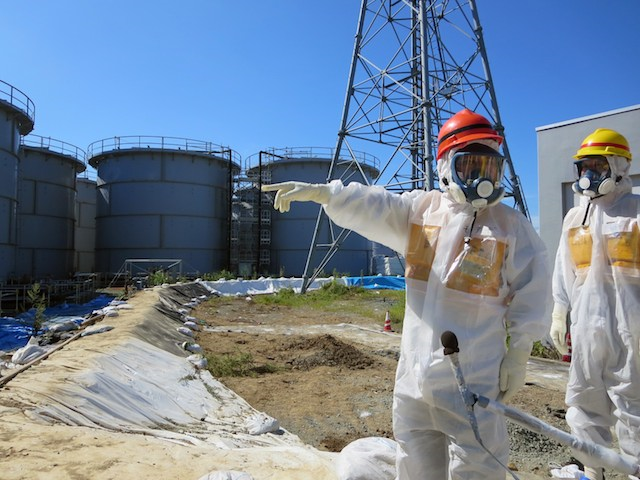
INSPECTING FUKUSHIMA. A handout picture provided by Tokyo Electric Power Co. (Tepco), shows Japanese Minister of Economy, Trade and Industry Toshimitsu Motegi (L) pointing to contaminated water storage tanks during his visit at the crippled Fukushima Daiichi Nuclear Power Plant in Okuma, northeast of Tokyo, Fukushima Prefecture, Japan, 26 August 2013. Photo: EPA / TEPCO / HANDOUT


The Guardian
Fukushima

Never Go Home?

 Read More Here


Could you imagine not being able to ever return home again for whatever reasons? Most of us would certainly be very upset and perturbed by such a situation. But that's exactly what the people who lived near the Fukushima nuclear plant are facing.

One leading Japanese Physicist remarked that had events spun out of control, then most of Northern Japan would have been uninhabitable. They are still not out of the woods yet, as there are many risks around the site that could trigger more disasters. Consequently there are many concerns that arise from this on-going situation that could also trigger a devastating financial crisis in Japan that would ripple through-out the world. Moreover, should Japan make a effort to rebuild from all this, then you can expect sharp increases in global interest rates to emerge.

Call it the Fukshima Financial Contagion - but that may be just the wake-up call we need to realize how fragile the overall energy situation is becoming. 

Dr Peter G Kinesa
November 18,2013


Home Sweet Home


Wednesday, October 23, 2013

#Fukushima Radiation - WHO's At Risk?


Fukushima
Radiation
Hitting the West Coast-
Who’s At Risk?
Read and View Video

This is not the time to get overly frightened and upset, nor is it the time to bury our heads in the sand and either hope or rationalize the dangers away. This above linked article provides anecdotal evidence with links to a variety of other stories, reporting the specific harms being done to the environment on the West Coast, possibly from the radioactive water of Fukushima. Is it possible that a distinct concentrated ocean current of this water had or could form causing such damage? - Yes, according to some scientific sources. 

Unfortunately, we cannot verify these scientific findings, conclusions and predictions one way or the other. That is one reason why we believe greater effort is needed from the world community.Moreover, the information that is coming out of Japan over the past two years has been inconsistent, contradictory and at times thought to be misleading. Contrast the effort here, to the eagerness and hyperbole surrounding efforts  to bomb Syria over its chemical weapons - and that was not even remotely threatening to North American shores. 

Again, we are not going to judge whether the risk is great or being overblown by media vigilantes, but what we do know is that this nuclear disaster has still not been contained after two years. There are indications too, that the spillage is getting worse. The Japanese Prime Minister has recently called out for global assistance. No one seems to know when this disaster is going to be fixed.These are all not adding up to a positive position for the world's third largest economy - as there are additional dangers of a major catastrophic financial fall-out spinning out of any escalated and protracted events. That would be a global event! . 

There are many known unknowns in play here, but here's the big unknown, unknown that should really concern the world.

What if there is another tsunami?  

To be quite frank, that or similar events, at this fragile point of time, is the biggest concern. We need, with the greatest urgency, to bring this  situation under control....

NOW!


Dr Peter G Kinesa
October 23, 2013


Risks of Fragile Times


Monday, October 21, 2013

#Fukushima - Out of Control?


The Japan Times 
Fukushima

OUT OF CONTROL?

See More Here


Just when you think that problems at this event could not get any worse,particularly after two years of site work. - They do!

As this linked article reports the radioactive water releases are up an astonishing 6500%.Not only is the future of Japan in the lurch, but so might be the North American western coastline as this water is sure to touch its shores. Should it be highly contaminated then you could overlay  in a few months the Fukushima wasteland pictures on cities all along the coast.  

Everyone fears what could happen should the catastrophe spread to the rest of the reactors on the site Apparently there are also 23 similar reactors in North America And this is no longer a Japanese problem. Rather, it is the world's biggest priority.


So, where is the world???


Dr Peter G Kinesa
October 21, 2013

Map of sampling locations for radioactive water leaks around the Fukushima Daiichi nuclear plant. Graphic: TEPCO 


Saturday, October 12, 2013

Japan's PM Sends #Fukushima SOS


Japan's PM Sends
Fukushima SOS

My country needs your knowledge and expertise”

(Al Jazeera America)
Read More Here


Almost daily the reactor at Fukushima faces new leaks of radioactive water as tanks overflow and spill their refuse into nearby seas. Over a month ago Japan had stated to the 2020 Olympic Committee, that the situation was under control. Not so, as reflected by their Prime Minister's recent call for international assistance. Japan's problems are also flowing over into the nuclear industry, that just had two multi-billion dollar projects more or less cancelled in a Canadian province.

It seems that the media is also playing down the consequences on the local fishing industry because local Sushi restaurants are in a business as usual mode. At this point it is hard to determine what the final outcomes will be until the situation is put to rest and some time has lapsed to allow for a damage assessment. There is little doubt its affects are far-reaching and may still have an impact on the larger economy as energy costs are certain to rise over time. 

Crippling the world's third largest economy is sure to have spreading global effects that may ultimately cause havoc in the global financial markets too. Therefore, it is self-evident why such a hush-hush environment exists around disclosure, events and media.

Meaning that we are going to continue monitoring developments as they are reported. Events here could dramatically change too many things, particularly when there is little evidence that they are contained or may even becoming worse?

Dr Peter G Kinesa
October 12, 2013  

Sunday, October 6, 2013

#Fukushima - Nuclear Wasteland (In Pictures)


A woman paying a brief visit to her home walks under a sign reading 'Nuclear power – the energy for a better future', at the entrance of the empty Futaba town. Decades ago the citizens ofFutaba took such pride in hosting part of the Fukushima Daiichi nuclear complex that they built a sign over a promenade proclaiming that atomic power made their town prosperous. Photo: Damir Sagolj / Reuters

Fukushima
Nuclear Wasteland
(In Pictures)

The Guardian provides an excellent gallery of pictures providing a visual insight into the worst atomic disaster in 25 years. The human, environmental and economic costs have been staggering and what the future holds remains deeply concerning. Words can only do so much as the actual photographs touch profounder meanings and understandings of the tragedies created by a system that ignores planetary constraints with its foolish neo-classical economic beliefs pushing exponential growth leading to the self-evident ultimate minimization of human life.  

As much as these pictures convey an education into the aftermath of this event, they are also disturbing in many ways. There is a shot of a fisherman selling his catch at what appears to be a local market. His produce is covered by plastic for protection??? The first amoung many serious questions that strike the mind is, "WHO IS EATING THIS FISH?  

"... what the future holds remains deeply concerning..."

Dr Peter G Kinesa
October 5, 2013 

Tuesday, September 17, 2013

Professor Erle C Ellis - Miracles to Save Japan and World Economy

Professor Erle C Ellis - Miracles to Save Japan and World Economy


(Read More) 


Fukushima Nuclear power plant  in Japan


This above linked article from The Guardian underscores our deep concerns about the world's third largest economy. The country is shutting down its last nuclear plant for maintenance and is unlikely to see a prompt return to this energy source any time soon. Maybe 2015. That means greater reliance on imports such as liquid natural gas  leading to soaring energy costs for business and consumers. Just another blow to an already long-ravaged economy.

This also affects export trade as costs will certainly rise. In order  to compete and maintain trade volumes, the yen will undergo a further period of downward pressures, but this creates a vicious circle as import cost will concurrently rise. Japan is starting to show the same symptoms as other resource strapped nations including the incumbent social unrest.

One final point, this all has nothing to do with overpopulation, resource scarcity, peak oil, climate change nor collapsing biodiversity according to the renowned Professor Erle C Ellis, University of Maryland. Predicting based on local sources that Japan is just moments from building a new top-super-secret technology that converts radioactive water into oil and other minerals. A miracle device that will allow for further exponential growth into a bright new future. Ellis believes that more miracles create the economic path to future prosperity   

Otherwise, the Japanese miracle is now just a long old memory!

Dr Peter G Kinesa
September 17, 2013


"Miracles - take at look at me now!"

Professor, Erle C Ellis, PHD


Motivate, Inspire, Positive