WORLD LEADING INSIGHTS

International LEADERS Calling Market Crashes Years Ahead
Second to None, Anywhere...

'Warned 2000 tech slide; predicted 2008 meltdown in 2007. Forecasted 2020 global economic collapse in 2011, AND NOW- BY 2050 - THE MOTHER OF ALL CRASHES"

Featured Post

#TROUBLE AHEAD AS #ICE SHELF DEVASTATED IN #ANTARCTIC

 REUTERS Thinning Antarctic ice shelf finally crumbles after heatwave By  Isla Binnie March 25 (Reuters) - An East Antarctica ice shelf disi...

Inspire, Achieve, Success

Search This Blog

SAVE ON HOT STUFF

Showing posts with label drought. Show all posts

Tuesday, May 26, 2015

California - Why So Dry?


California Drought Caused By Climate Change


Human released greenhouse gas pollution changes the climatic system through a variety of mechanisms. Trade winds and jet streams change their patterns of movement, and the distribution of moisture in the air changes, with precipitation either lacking more than usual or being more abundant than usual. The patterns of movement of major air masses and the increased bifurcation of air masses into more wet than usual and more dry than usual can result in long periods where region experiences excess precipitation or a lack of precipitation. When the latter happens, there can be a drought.


Increasingly, the California drought is being seen as an effect of climate change. Air masses that should have contributed precipitation in the form of mountain snow, which in turn feed the western ground water system, have been kept away. Increased temperature has increased evaporation. Other factors related to climate change have contributed. The result is an historic drought over California that shows at present no sign of stopping any time soon. There was hope that last winter there would be additional precipitation, and there was some, but not enough. Read More

Tuesday, April 21, 2015

#HEATWAVE - Seriously, Can #California Survive? - #Bloomberg Article

California's New Era of

Heat Destroys All

Previous Records

Sadly, this is only the beginning


The California heat of the past 12 months is like nothing ever seen in records going back to 1895. The 12 months before that were similarly without precedent. And the 12 months before that? A freakishly hot year, too. 

Where's The Polar Vortex - Extremes Everywhere? 


What's happening in California right now is shattering modern temperature measurements—as well as tree-ring records that stretch back more than 1,000 years. It's no longer just a record-hot month or a record-hot year that California faces. It's a stack of broken records leading to the worst drought that's ever beset the Golden State.  Read More


REMEMBER 
Unbelievably Sad, With Drought Comes Intenser Fire Seasons


Wednesday, April 8, 2015

SAO PAULO - #Brazil - STILL DRY DESPITE RECORD RAINS


SAO PAULO STILL DRY DESPITE RECORD RAINS

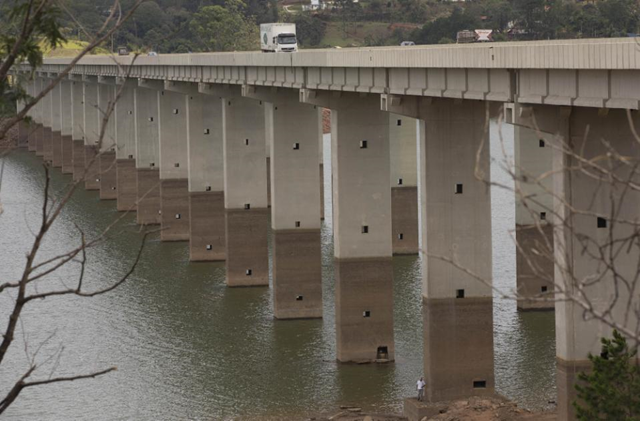
In this 29 January 2015 file photo, a bridge's columns are marked by the previous water line over the Atibainha reservoir, part of the Cantareira System that provides water to the Sao Paulo metropolitan area, in Nazare Paulista, Brazil. In 2015, Brazil's biggest city recorded its rainiest March since 2008, but the worst drought in more than 80 years has left reservoir levels critically low, and water experts fear that strict water rationing may still loom for Sao Paulo as it enters the April-September dry season. Photo: Andre Penner / AP Photo


By Stan Lehman 
2 April 2015
SÃO PAULO (Associated Press) – Brazil's biggest city has recorded its rainiest March since 2008, but the worst drought in more than 80 years has left reservoir levels critically low and water experts fear that strict water rationing may still loom for São Paulo as it enters the April-September dry season.
The crucial Cantareira water system, which provides water to about 6 million of the 20 million in the metropolitan area, was still only about one-fifth full as the dry season began.
Authorities already have imposed water-saving measures, including cut rates for people who limit usage, reduced pressure in water lines during off-peak hours and de facto rationing: some areas receive water only half the day.
Environment Minister Izabella Teixeira said this week that those programs must be expanded, and the government is preparing "a rational water-use program, given the end of the rainy season." She offered no details.
But some think that may not be enough.
Mario Thadeu Leme de Barros, head of the University of São Paulo's hydraulic engineering and environmental department, said existing measures, combined with the transfer of water among reservoirs, "will hopefully allow us to reach the end of the year with the mini-rationing that exists."
He also called for the use of more efficient appliances, the use of wastewater and better detection of leaks in a system that loses more than 30 percent of its water to leaks.
"But we cannot discard the possibility of more harsh water rationing measures should we be hit with an even worse drought during the coming dry season," he said.
Moody's Investors Service warned last month that water rationing looks increasingly likely, adding, "Overall, mandatory federal or state water rationing would worsen Brazil's already sluggish economic growth."
In March, São Paulo, received 8.13 inches (206.5 millimeters) of rain, 16 percent above the average, boosting the level of the Cantareira system from 5 percent to nearly 19 percent of its capacity, the water utility Sabesp said Thursday on its website.
The other five systems were at 23 percent to 97 percent of capacity as the dry season started.

Time For A New Rain Dance


Thursday, April 24, 2014

HUGE FOOD PRICE SHOCKS AHEAD


California drought to cause fruit and veggie sticker shock


By Adam Shell   


GTY 474893301 A ENV NAR USA CA(America’s Markets) – The price of  fruits and veggies is going up, causing possible sticker shock at the grocery store checkout. Blame one of California’s worst droughts ever for the rising prices.    Crop shortages, ranging from 10% to 20% depending on the type of crop, will lead to the higher prices, says professor Timothy Richards of the W. P. Carey School of Business at Arizona State University, citing recently completed research on which crops will likely be most affected.    “You’re probably going to see the biggest produce price increases on avocados, berries, broccoli, grapes, lettuce, melons, peppers, tomatoes and packaged salads,” says Richards. “We can expect to see the biggest percentage jumps in prices for avocados and lettuce – 28% and 34%, respectively.” Richards estimates the following possible price increases due to the drought:


  • Avocados likely to go up 17  to 35 cents to as much as $1.60 each.
  • Berries likely to rise 21 to 43 cents to as much as $3.46 per clamshell container.
  • Broccoli likely to go up 20 to 40 cents to a possible $2.18 per pound.
  • Grapes likely to rise 26 to 50 cents to a possible
  • $2.93 per pound.
  • Lettuce likely to rise 31 to 62 cents to as much as $2.44 per head.
  • Packaged salad likely to go up 17 to 34 cents to a possible $3.03 per bag.
  • Peppers likely to go up 18 to 35 cents to a possible $2.48 per pound.
  • Tomatoes likely to rise 22 to 45 cents to a possible $2.84 per pound.


Industry estimates range from a half-million to 1 million acres of agricultural land likely to be affected by the current California drought. Richards believes 10% to 20% of the supply of certain crops could be lost. California is the biggest national supplier of several of those crops. For avocados, the state is the only major domestic source. […]  


   “We predict the increased prices will change consumer purchasing behavior,” says Sherry Frey, vice president of Nielsen Perishables Group. [more]


Read More


Climate leads to Higher Food Costs. "Period."
 
End of Story.


Comments
 
This is when climate change really starts to hit home - when it actually shows up at the dinner table. In the price that is. But what is more concerning is that there is much more to come. - then what?
 
Maybe we should start to think about what we really mean by economics?
 
Dr Peter G Kinesa
April 24,2014
 

Monday, April 21, 2014

California WATER Reserviors Drying UP


Stunning Before and After Photos of California's Lakes Depleted by Extreme Drought


By Chris Dolce


Aerial view of California's Folsom Lake, before the record drought dried it up. Photo: Google Earth
BEFORE
(Weather Channel) –

 California's reservoirs are severely depleted due to the ongoing widespread drought conditions in the state. As of 21 January 2014, 67 percent of California was in extreme drought [69% on 8 April 2014], the second worst category possible on the U.S. Drought Monitor [now 23% in “Exceptional” drought, the worst category].

According to the California Department of Water Resources, Lake Shasta and Lake Oroville are only 36 percent of capacity. Folsom Lake is just 17 percent capacity.  
Home Page
AFTER
Starting with Folsom Lake above, we've matched up recent photos of these three depleted lakes from the California Department of Water Resources with images from Google Earth that show the lakes when they were much fuller.


Read More


Here's More

Thursday, March 20, 2014

Wells Run Dry - California

Its most unsettling threat yet: It could run out of water by summer.

By ADAM NAGOURNEY


LAKE OF THE WOODS, California (The New York Times) –  People in this mountain town straddling the San Andreas Fault are used to scrapping for water. The lake for which it is named went dry 40 years ago. But now, this tiny community is dealing with its most unsettling threat yet: It could run out of water by summer.


Lake of the Woods, a small community north of Los Angeles, is running dry amid a deep California drought. A sign announces the town's water levels. Residents are changing water habits, but many worry about the future. Photo: Matt Black / The New York TimesAs of last week, just two of the five wells drilled into the dry lake bed that serve its 300 homes were producing water. The mountains of the nearby Los Padres National Forest got their first dusting of snow — and it was a light one — last week; it is the winter snow that feeds the wells come spring. People are watering trees with discarded dishwater, running the washing machine once a week, and letting their carefully tended beds of flowers and trees wither into patches of dusty dirt.

There are scenes all across California that illustrate the power of the drought. A haze of smog, which normally would be washed away by winter rains, hung over Los Angeles this week. Beekeepers near Sacramento said the lack of wildflowers has deprived bees of a source of food, contributing to a worrisome die-off. Across the rich farmland of the San Joaquin Valley, fields are going unplanted.


But for 17 small rural communities in California, the absence of rain is posing a fundamental threat to the most basic of services: drinking water. And Lake of the Woods, a middle-class enclave 80 miles from downtown Los Angeles, a mix of commuters, retirees and weekend residents, is one of the most seriously threatened. Signs along its dusty roadways offer stark red-on-white warnings of a “Water Emergency” and plead for conservation.  (Read More)

More News


Motivate, Inspire, Positive