WORLD LEADING INSIGHTS

International LEADERS Calling Market Crashes Years Ahead
Second to None, Anywhere...

'Warned 2000 tech slide; predicted 2008 meltdown in 2007. Forecasted 2020 global economic collapse in 2011, AND NOW- BY 2050 - THE MOTHER OF ALL CRASHES"

Featured Post

#TROUBLE AHEAD AS #ICE SHELF DEVASTATED IN #ANTARCTIC

 REUTERS Thinning Antarctic ice shelf finally crumbles after heatwave By  Isla Binnie March 25 (Reuters) - An East Antarctica ice shelf disi...

Inspire, Achieve, Success

Search This Blog

SAVE ON HOT STUFF

Showing posts with label ecology. Show all posts

Monday, June 15, 2015

Canadian Leaders Know Tar Sands Huge Risk

Document Shows Canadian Government  Fully Aware of Tar Sands Dangers


A document recently released under Canada's access-to-information law reveals that Canadian government officials have been aware of the proliferation of contaminants associated with tar sands mining even as they continues to promote industry expansion with minimal regulation. The January 2015 briefing note, prepared for Natural Resources Minister Greg Rickford, discusses findings from a tar sands monitoring report published in December 2014 describing dangerous concentrations of iron and cadmium in Alberta's wetlands and of phosphorus and nitrogen in the Athabasca River.


In addition, increased concentrations of polycyclic aromatic hydrocarbons (PAH) in the toxic tailings ponds near tar sands strip mines are raising PAH levels in the atmosphere, which can lead to human health concerns like DNA damage and impaired development. The briefing note also highlights serious declines in species that rely on old forest habitat, which has been decimated by mining operations. Yet even with the knowledge furnished by this briefing note, the Canadian government has continued to promote the expansion of the tar sands industry, particularly through its support for tar sands pipelines like Keystone XL and Energy East.


We Stand On Guard For Thee


Wednesday, June 10, 2015

Bullwinkle Reports Warm Weather Ticks Attack Moose Population

Warming climate and winter ticks decimating moose populations


BROWNVILLE, Maine — Chris Read is the owner of the Gunsmoke Lodge in Brownville, Maine, and, along with many of his patrons, is a lifelong hunter of Maine’s wildlife, including moose.
But these days, he is worried. Though the state’s last official count of its moose population, in 2012, put the number of moose roaming Maine’s forests and mountains at about 76,000, he no longer believes that is accurate.


“I think the state’s numbers of deer moose are way off,” Read said. “I’m guessing it’s more like 50,000 to 55,000. It’s just my theory, based on sightings. I think the moose population is definitely in decline.”
He is not alone in his fears. Hunters, academics and environmentalists fear that moose numbers across Maine and in other parts of the U.S. are experiencing a worrying decline in numbers in the face of deadly ticks that are decimating populations. And at the root of the parasite problem could be something much harder to control: climate change. Read More.

Not Just A Cartoon


Monday, June 8, 2015

Sea Lion Pups Starving In California


Number of Starving Sea Lions in California 'Unprecedented'

Rescuers say that more than 3,000 baby sea lions have washed ashore this year, raising questions about what the future holds after three years of mass strandings.


“It’s unprecedented,” says Sarah Wilkin, national marine mammal stranding and emergency response coordinator for the National Oceanic and Atmospheric Administration.
And those are the lucky pups. The situation on California’s Channel Islands, where more than 90 percent of the U.S. sea lion population congregates to breed and nurse young, is even worse than in other parts of the state. Read More
Can Sea Lions Survive Without Man?

Thursday, May 28, 2015

FIRE Causes Mass Alberta Oilsands Evacuation


Alberta forest fire forces evacuation of oilsands facilities


Cenovus Energy and Canadian Natural Resources Limited have evacuated their facilities within the Cold Lake Air Weapons range, close to Alberta's eastern border, due to an out-of-control forest fire in the area.
"Yesterday, CNRL evacuated their plant facilities in the Primrose area and then, last night at 11 o'clock, we advised Cenovus in Foster Creek that it would be a good precautionary move to evacuate their personnel as well," said  Leslie Lozinski, spokeswoman for the province's environmental and resource ministry.
Cenovus evacuated their facilities at Foster Creek because the fire threatened the only road out, which would have made any evacuation of the facility difficult. Read More

 Alberta Bound??

Thursday, April 30, 2015

Hellish Red Pacific Sunsets From Siberia Wildfires

Smoke from Siberian wildfires turns Northwestern sunsets a fiery red


Trajectory of smoke from wildfires in Siberia as it travels over the central Pacific ocean to U.S. Pacific Northwest in April 2015. Graphic: NOAA

The scenes have almost felt like they're out of Hollywood imagination -- brilliant red sunrises and sunsets the last couple of days around Western Washington. 

Why so red? It's a byproduct of the massive wildfires that recently burned a large area in Siberia. 


Embedded image permalink


The atmospheric winds are aligned this week to carry the smoke across the Pacific Ocean and into the Pacific Northwest. 

First up, to get an idea of just how much smoke is in the atmosphere, look at this visible satellite image taken on April 14 of the southeastern Siberia area where the wildfires got out of control: Read More


Ironically Coined 


"The GATES of Hell "


Dr. Kinesa's - Global Edge


Anybody remember the last line in that book by Milton, Paradise Lost? I think it had something to do with heaven and hell in our minds. 

Oh well... 


International Offices
April 30,2015

Friday, April 24, 2015

TOP SECRET #ECB CHART - No Bees = No FOOD in Europe?

Nearly one in 10 wild bee species face extinction in Europe while the status of more than half remains unknown - IUCN report


Major threats to bees in Europe. Graphic: IUCN

The first-ever assessment of all European wild bee species shows that 9.2% are threatened with extinction, while 5.2% are considered likely to be threatened in the near future. A total of 56.7% of the species are classified as Data Deficient, as lack of experts, data and funding has made it impossible to evaluate their extinction risk. 
The assessment was published today as part of The IUCN European Red List of Bees and the Status and Trends of European Pollinators (STEP) project, both funded by the European Commission. It provides – for the first time – information on all 1,965 wild bee species in Europe, including their status, distribution, population trends and threats. Read More.

CAN WE SERVIVE WITHOUT BEES


Wednesday, April 22, 2015

DEAD SEA Is Truly Dying As #Sinkholes Grow

Sinkholes as Deep as Eight-Story Buildings Form Along Shoreline of the Disappearing Dead Sea


Sinkholes Litter Shorelines Spelling Doom For Sea


The Dead Sea is disappearing at an alarming rate, leaving behind thousands of sinkholes that are chipping away at the coastline's vibrant and touristy atmosphere.
The Dead Sea - which is actually a lake - is known for being almost 10 times as salty as the ocean and for having the lowest elevation on Earth. However, over the last few decades, the shoreline has become known for sinkholes that appear to just pop up out of nowhere.

Grand Canyon II?


More than 3,000 sinkholes exist along the banks of the Dead Sea, ABC News reported. And some of these craters dive 80 feet into the ground - the equivalent of about an eight-story building. Read More.

Dead Sea Is Drying Up


Saturday, April 11, 2015

#McKinsey & Co Implies Mother Nature Asks #Humanity To Reschedule Global Debt

McKinsey & Co - Debt And (Not Much) Deleveraging 


Global debt growth, 2000-2014. Global debt has increased by $57 trillion since 2007. China's debt has quadrupled. Graph: McKinsey Global Institute


Seven years after the bursting of a global credit bubble resulted in the worst financial crisis since the Great Depression, debt continues to grow. In fact, rather than reducing indebtedness, or deleveraging, all major economies today have higher levels of borrowing relative to GDP than they did in 2007. Global debt in these years has grown by $57 trillion, raising the ratio of debt to GDP by 17 percentage points (Exhibit 1). That poses new risks to financial stability and may undermine global economic growth.


A new McKinsey Global Institute (MGI) report, Debt and (not much) deleveraging, examines the evolution of debt across 47 countries—22 advanced and 25 developing—and assesses the implications of higher leverage in the global economy and in specific sectors and countries. The analysis, which follows our July 2011 report Debt and deleveraging: The global credit bubble and its economic consequences and our January 2012 report Debt and deleveraging: Uneven progress on the path to growth, focuses on the debt of the “real economy”: governments, nonfinancial corporations, and households. It finds that debt-to-GDP ratios have risen in all 22 advanced economies in the sample, by more than 50 percentage points in many case. Read More.


Why Is Mother Nature Crying About Global Debt Expansion?


Image result for mother nature crying earth


Monday, April 6, 2015

#BBC #Mongolia Sludges Into Ecological Nightmare

The Dystopian Lake Filled By The World's Tech Lust


Hidden in an unknown corner of Inner Mongolia is a toxic, nightmarish lake created by our thirst for smartphones, consumer gadgets and green tech, discovers Tim Maughan. Black sludge pours into the lake - one of many pipes lining the shore. Photo: Liam Young / Unknown Fields

From where I'm standing, the city-sized Baogang Steel and Rare Earth complex dominates the horizon, its endless cooling towers and chimneys reaching up into grey, washed-out sky. Between it and me, stretching into the distance, lies an artificial lake filled with a black, barely-liquid, toxic sludge.
Dozens of pipes line the shore, churning out a torrent of thick, black, chemical waste from the refineries that surround the lake. The smell of sulphur and the roar of the pipes invades my senses. It feels like hell on Earth. Read More


"Rare Earth" 
Such An Ironic Twist of Words


Monday, June 16, 2014

#Oregon Stars Are Dying - No More Twinkle, Twinkle...

Sea star disease epidemic surges in Oregon, local extinctions expected


 Contact: David Stauth, 541-737-0787; Kristen Milligan, 541-737-8862


CORVALLIS, Oregon (OSU) – Just in the past two weeks, the incidence of sea star wasting syndrome has exploded along the Oregon Coast and created an epidemic of historic magnitude, one that threatens to decimate the entire population of purple ochre sea stars.

Prior to this, Oregon had been the only part of the West Coast that had been largely spared this devastating disease.


A dying sea star. The leg of this purple ochre sea star in Oregon is disintegrating, as it dies from sea star wasting syndrome, 16 May 2014. Oregon had been the only part of the West Coast that had been largely spared this devastating disease. Photo: Elizabeth Cerny-Chipman / Oregon State University / flickr
The ochre sea star, which is the species most heavily affected by the disease in the intertidal zone, may be headed toward localized extinction in Oregon, according to researchers at Oregon State University who have been monitoring the outbreak. As a “keystone” predator, its loss could disrupt the entire marine intertidal ecosystem.

Researchers say this is the first time that die-offs of sea stars, more commonly known as starfish, have ever been identified at one time along such a wide expanse of the West Coast, and the sudden increase in Oregon has been extraordinary.
The best information is from the intertidal zone, which is easier to access for monitoring. In this area, less than 1 percent of the ochre sea stars in Oregon were affected in April, and only slightly more than that by mid-May.


Baffling Scientists?
Watch!


Today, an estimated 30-50 percent of the Oregon populations of this sea star species in the intertidal zone have the disease. The highest losses are at Fogarty Creek, where about 60 percent are affected. Researchers project that the epidemic will intensify and, at some sites, nearly 100 percent of the ochre sea stars could die.


Read More


"Say Dad, did you hear the news about Oregon?"
"Very sad, son"


Add caption

Friday, June 13, 2014

BIG Oil Ravages #Amazon National Park


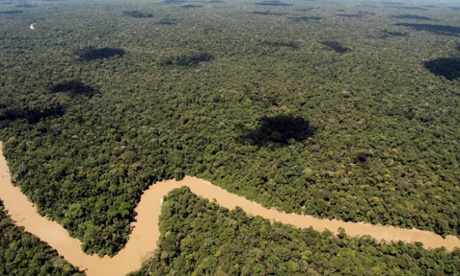
Aerial view of activists in Ecuador's Yasuní national park spelling 'Vive Yasuní' with their bodies. Photo: Progreso SemanalEcuador signs permits for oil drilling in Amazon's Yasuni national park

Companies could start extracting oil underneath key biodiversity reserve on Earth by 2016


By Adam Vaughan   


Yasuni national park
(theguardian.com) – Drilling for oil in a part of the Amazon rainforest considered one of the most biodiverse hotspots on the planet is to go ahead less than a year after Ecuador's president lifted a moratorium on oil drilling there.
Last August, Rafeal Correa scrapped a pioneering scheme, the Yasuní Ishpingo-Tambococha-Tiputini (ITT) initiative, to keep oil in the ground under a corner of the Yasuní national park in return for donations from the international community.

He said only $13m (£8m) of the $3.6bn goal had been given, and that "the world has failed us", giving the green light to drilling.

On Thursday, environment minister, Lorena Tapia, said permits for drilling had been signed for the 6,500-square-mile reserve, known as block 43, and oil production might begin as soon as 2016.

The permits allow Petroamazonas, a subsidary of the state oil company, to begin construction of access roads and camps to prepare for drilling.

Esperanza Martinez, an environmental activist in Ecuador, was quoted in a leading national daily as saying Petroamazonas had a bad record on oil spills and it could not be trusted to drill safely in the Yasuní-ITT.

Earlier this month, Ecuador's government rejected a petition calling for abandoning plans for drilling in the area, saying the organisers had failed to get enough signatures to trigger a national referendum.

The petition's backers, YASunidos, accused the government of fraud after only 359,762 signatures of around 850,000 submitted were deemed genuine – the threshold for forcing a referendum is 583,323.


Read More


Can trees survive without Man? 
Can Man survive without...

SHOCKING!


Monday, June 2, 2014

#MIT - Climate More BIG Storms Up North

Study: Dangerous storms peaking further north, south than in past

New analysis of cyclones shows migration away from tropics and toward the poles in recent decades.


Peter Dizikes


(MIT News Office) – Powerful, destructive tropical cyclones are now reaching their peak intensity farther from the equator and closer to the poles, according to a new study co-authored by an MIT scientist.


The results of the study, published today in the journal Nature, show that over the last 30 years, tropical cyclones — also known as hurricanes or typhoons — are moving poleward at a rate of about 33 miles per decade in the Northern Hemisphere and 38 miles per decade in the Southern Hemisphere.    “The absolute value of the latitudes at which these storms reach their maximum intensity seems to be increasing over time, in most places,” says Kerry Emanuel, an MIT professor and co-author of the new paper.


“The trend is statistically significant at a pretty high level.”

   And while the scientists who conducted the study are still investigating the atmospheric mechanisms behind this change, the trend seems consistent with a warming climate.


“It may mean the thermodynamically favorable conditions for these storms are migrating poleward,” adds Emanuel, the Cecil and Ida Green Professor of Earth and Planetary Sciences at MIT.    The implications are serious, since the movement of peak intensity means regions further north and south of the equator, which have not previously had to face many landfalls by violent cyclones, may now have greater exposure to these extreme weather events.

That, in turn, could lead to “potentially profound consequences to life and property,” the paper states. “Any related changes to positions where storms make landfall will have obvious effects on coastal residents and infrastructure.”


Moving with the trade winds?


Read More


WOW! It is going to get worse?


Doc's Comments:
 
As things get worse the deniers persist to try to keep the lid on legitimate science. In the end, they will get what they deserve; while many innocents are caught up in the storms. Very sad. 
 
Dr. Peter G Kinesa
June 2, 2014


Wednesday, May 21, 2014

IT'S ALL OVER! #Nature is Dying

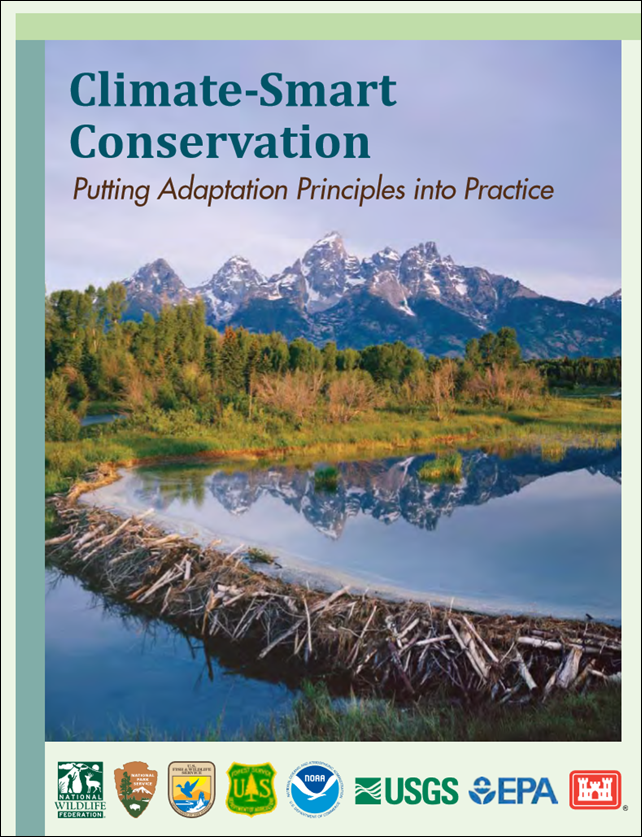
Cover of the National Wildlife Federation report, 'Climate-Smart Conservation', 2014. Photo: National Wildlife Federation

Impossible to Conserve Nature As Is, Thanks to Climate Change


A U.S. government-backed guide for land managers says global warming requires a fundamental shift in conservation


By Elizabeth Harball and ClimateWire


conservation
(Scientific American) – When President Theodore Roosevelt visited the Grand Canyon in 1903, he famously admonished the attending crowd to avoid meddling with the landscape. "Leave it as it is. You cannot improve on it," he said. 

True to Roosevelt's message, America's conservationists have since focused on maintaining the status quo, or at least restoring ecosystems to their natural state.

But due to the growing impacts of climate change, this can no longer continue, according to a new guide for land managers backed by multiple state and federal agencies.

"Addressing the growing threats brought about or accentuated by rapid climate change requires a fundamental shift in the practice of natural resource management in conservation," states the document, released yesterday by the National Wildlife Federation in partnership with the National Park Service, U.S. EPA, the National Oceanic and Atmospheric Administration, the U.S. Geological Survey and several other federal agencies and nongovernmental organizations.

"While managers traditionally have looked to the past for inspiration, increasingly we will be faced with future conditions that may have no historical analogs," it states.


The guide is intended to demystify climate adaptation for habitat and wildlife managers. It provides a step-by-step process evaluating how ecosystems may be vulnerable to climate change and how conservation goals might be altered for the best possible outcome.


‘No longer possible’ to maintain nature's status quo


Read More


And More Video


Thursday, April 17, 2014

Miami Herald Prediction: Climate Means Dior Future


Climate change has arrived


OUR OPINION: Dire future if no action is taken

Read more here: http://www.miamiherald.com/2014/04/13/4054744/climate-change-has-arrived.html#storylink=cpy

MIAMI HERALD:Editorial


13 April 2014 (Miami Herald) – In case there was still any doubt, and there shouldn't be at this point, the Intergovernmental Panel on Climate Change, a United Nations group of scientists, has made it official: Climate change is not coming, it’s already here. And it’s going to get worse unless the whole world — especially the industrial world — greatly reduces greenhouse emissions causing global warming.

 
Climate change in the Arapaho glacial melt in Colorado.

 
The U.N. panel periodically weighs in on the state of the Earth’s climate. Its latest report cites melting ice caps, collapsing sea ice in the Arctic, heat waves and heavy deluges that are increasing in intensity and threatening crops, bringing on concerns about sustainable food supplies. Coral reefs are dying. Oceans are rising, while the oceans’ waters are becoming more acidic as they absorb carbon dioxide emitted by vehicles and power plants.


Then there's Florida...


“Climate change impacts are projected to slow down economic growth, make poverty reduction more difficult, further erode food security, and prolong existing and new poverty traps” in urban areas and emerging “hot spots” of hunger, the report says. Some of the people most at risk have little to do with causing global warming. Low-lying countries like Bangladesh and island nations in the Pacific Ocean could be the worst hit over the next few decades. 

Thursday, April 10, 2014

Former US Governor Calls For Climate Change Wake-up


A farmer and his children plant a field with bean seeds and fertilizer in southern Ethiopia in 2008, a year after severe floods destroyed most of the food crop. Ethiopia is the country 10th most vulnerable to climate change effects, <a href='http://www.cnn.com/2013/10/29/world/climate-change-vulnerability-index/index.html'>according to a 2013 report by Maplecroft</a>.

Bill Richardson

Wake up to the reality of climate change


By Bill Richardson


(CNN) – "Nothing poses a bigger threat to our water, our livelihood and our quality of life than a warming climate." Those are my words from 2006 upon the signing of an executive order on climate change for New Mexico when I was governor. 

Floodwaters course through Odo Ona in Nigeria's Oyo State in 2011. At least 102 people were killed when a dam burst during torrential rain.


 Almost a decade later, this statement still holds true. But now we have even more information about climate change, both the risks and solutions. 


The just-released report by the Intergovernmental Panel on Climate Change (IPCC), a collection of more than 800 leading climate scientists, reaffirms that climate impacts are already occurring and having a dramatic impact on society. Climate change is driven by our dependence on fossil fuels and is expected to get worse. In order to shift directions, we need nothing less than to rethink how we power our country.

Residents of Jacmel, Haiti, make their way through floodwaters as Tropical Storm Isaac dumps heavy rains in August 2012. An extreme exposure to climate-related events, combined with poor health care access, weak infrastructure, high levels of poverty and an over-reliance on agriculture have led to the country being categorized as at "extreme" risk. Here's what we know: 

The climate science is settled. The IPCC report is the latest addition to a staggering body of scientific research connecting our energy choices to costly climate disruption. The report is consistent with several other authorities -- such as the National Academy of Sciences, U.S. Global Change Research Program, and the National Oceanic and Atmospheric Administration -- that bring stronger language and greater certainty about climate change and its risks. Just as we know that smoking causes cancer, we understand that human activity causes climate change. 


Bangladeshis attempt to stay dry above flood waters in the capital, Dhaka. Bangladesh was ranked by Maplecroft the country most vulnerable to climate change, and Dhaka the world's most vulnerable city, due to its exposure to threats such as flooding, storm surge, cyclones and landslides, its susceptible population and weak institutional capacity to address the problem.
 Climate change is happening now and we are all feeling the effects. Earlier this month, the American Association of Advancement of Science reminded us that "climate change is happening here and now." 


Tainted water pours into a containment pond in a Unity field processing facility in what is now South Sudan, where there are concerns about the environmental damage being caused by the oil industry.We are now witnessing how it is changing our world: The past winter was the eighth-warmest on record. For 348 consecutive months -- 29 years -- global temperatures have been above average


Read More 


Long-time Activist and Hero
Bill Richardson -2007

Motivate, Inspire, Positive