WORLD LEADING INSIGHTS

International LEADERS Calling Market Crashes Years Ahead
Second to None, Anywhere...

'Warned 2000 tech slide; predicted 2008 meltdown in 2007. Forecasted 2020 global economic collapse in 2011, AND NOW- BY 2050 - THE MOTHER OF ALL CRASHES"

Featured Post

#TROUBLE AHEAD AS #ICE SHELF DEVASTATED IN #ANTARCTIC

 REUTERS Thinning Antarctic ice shelf finally crumbles after heatwave By  Isla Binnie March 25 (Reuters) - An East Antarctica ice shelf disi...

Inspire, Achieve, Success

Search This Blog

SAVE ON HOT STUFF

Showing posts with label #markets. collapse. Show all posts

Saturday, April 11, 2015

#McKinsey & Co Implies Mother Nature Asks #Humanity To Reschedule Global Debt

McKinsey & Co - Debt And (Not Much) Deleveraging 


Global debt growth, 2000-2014. Global debt has increased by $57 trillion since 2007. China's debt has quadrupled. Graph: McKinsey Global Institute


Seven years after the bursting of a global credit bubble resulted in the worst financial crisis since the Great Depression, debt continues to grow. In fact, rather than reducing indebtedness, or deleveraging, all major economies today have higher levels of borrowing relative to GDP than they did in 2007. Global debt in these years has grown by $57 trillion, raising the ratio of debt to GDP by 17 percentage points (Exhibit 1). That poses new risks to financial stability and may undermine global economic growth.


A new McKinsey Global Institute (MGI) report, Debt and (not much) deleveraging, examines the evolution of debt across 47 countries—22 advanced and 25 developing—and assesses the implications of higher leverage in the global economy and in specific sectors and countries. The analysis, which follows our July 2011 report Debt and deleveraging: The global credit bubble and its economic consequences and our January 2012 report Debt and deleveraging: Uneven progress on the path to growth, focuses on the debt of the “real economy”: governments, nonfinancial corporations, and households. It finds that debt-to-GDP ratios have risen in all 22 advanced economies in the sample, by more than 50 percentage points in many case. Read More.


Why Is Mother Nature Crying About Global Debt Expansion?


Image result for mother nature crying earth


Monday, June 16, 2014

#Oregon Stars Are Dying - No More Twinkle, Twinkle...

Sea star disease epidemic surges in Oregon, local extinctions expected


 Contact: David Stauth, 541-737-0787; Kristen Milligan, 541-737-8862


CORVALLIS, Oregon (OSU) – Just in the past two weeks, the incidence of sea star wasting syndrome has exploded along the Oregon Coast and created an epidemic of historic magnitude, one that threatens to decimate the entire population of purple ochre sea stars.

Prior to this, Oregon had been the only part of the West Coast that had been largely spared this devastating disease.


A dying sea star. The leg of this purple ochre sea star in Oregon is disintegrating, as it dies from sea star wasting syndrome, 16 May 2014. Oregon had been the only part of the West Coast that had been largely spared this devastating disease. Photo: Elizabeth Cerny-Chipman / Oregon State University / flickr
The ochre sea star, which is the species most heavily affected by the disease in the intertidal zone, may be headed toward localized extinction in Oregon, according to researchers at Oregon State University who have been monitoring the outbreak. As a “keystone” predator, its loss could disrupt the entire marine intertidal ecosystem.

Researchers say this is the first time that die-offs of sea stars, more commonly known as starfish, have ever been identified at one time along such a wide expanse of the West Coast, and the sudden increase in Oregon has been extraordinary.
The best information is from the intertidal zone, which is easier to access for monitoring. In this area, less than 1 percent of the ochre sea stars in Oregon were affected in April, and only slightly more than that by mid-May.


Baffling Scientists?
Watch!


Today, an estimated 30-50 percent of the Oregon populations of this sea star species in the intertidal zone have the disease. The highest losses are at Fogarty Creek, where about 60 percent are affected. Researchers project that the epidemic will intensify and, at some sites, nearly 100 percent of the ochre sea stars could die.


Read More


"Say Dad, did you hear the news about Oregon?"
"Very sad, son"


Add caption

Friday, June 13, 2014

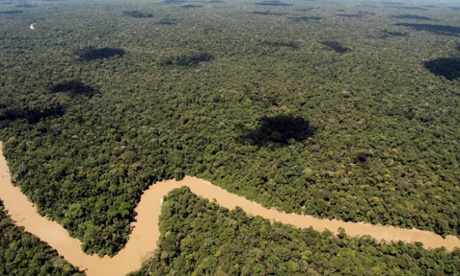
BIG Oil Ravages #Amazon National Park


Aerial view of activists in Ecuador's Yasuní national park spelling 'Vive Yasuní' with their bodies. Photo: Progreso SemanalEcuador signs permits for oil drilling in Amazon's Yasuni national park

Companies could start extracting oil underneath key biodiversity reserve on Earth by 2016


By Adam Vaughan   


Yasuni national park
(theguardian.com) – Drilling for oil in a part of the Amazon rainforest considered one of the most biodiverse hotspots on the planet is to go ahead less than a year after Ecuador's president lifted a moratorium on oil drilling there.
Last August, Rafeal Correa scrapped a pioneering scheme, the Yasuní Ishpingo-Tambococha-Tiputini (ITT) initiative, to keep oil in the ground under a corner of the Yasuní national park in return for donations from the international community.

He said only $13m (£8m) of the $3.6bn goal had been given, and that "the world has failed us", giving the green light to drilling.

On Thursday, environment minister, Lorena Tapia, said permits for drilling had been signed for the 6,500-square-mile reserve, known as block 43, and oil production might begin as soon as 2016.

The permits allow Petroamazonas, a subsidary of the state oil company, to begin construction of access roads and camps to prepare for drilling.

Esperanza Martinez, an environmental activist in Ecuador, was quoted in a leading national daily as saying Petroamazonas had a bad record on oil spills and it could not be trusted to drill safely in the Yasuní-ITT.

Earlier this month, Ecuador's government rejected a petition calling for abandoning plans for drilling in the area, saying the organisers had failed to get enough signatures to trigger a national referendum.

The petition's backers, YASunidos, accused the government of fraud after only 359,762 signatures of around 850,000 submitted were deemed genuine – the threshold for forcing a referendum is 583,323.


Read More


Can trees survive without Man? 
Can Man survive without...

SHOCKING!


Wednesday, June 11, 2014

A NEW ATLANTIS- #MIAMI Sinking!

Miami’s rising sea level is an enormous problem


In Miami Beach, Henry Briceño, a professor at Florida International University’s Southeast Environmental Research Center has been trying to raise awareness on how global warming is affecting his own community.


By Chiamaka Nwakeze
Miami’s rising sea level is an enormous problem(Science Recorder ) – Eighteen American scientific societies including the American Association for the Advancement of Science (AAAS), the U.S. National Academy of Sciences (NAS) and the Intergovernmental Panel on Climate Change (IPCC) have reached a consensus on global warming, namely that it is occurring and is largely attributable to human activities. These rising temperatures create significant changes in weather patterns across the globe, resulting in stronger hurricane storms, loss of natural habitats, species extinctions and rising sea levels.
In Miami Beach, Henry Briceño, a professor at Florida International University’s Southeast Environmental Research Center, has been trying to raise awareness on how global warming is affecting his own community.
Briceño has begun to sample the water around Miami Beach and has found high levels of nutrients such as nitrogen, which indicates that the quality of the water is poor. And like many scientists, Briceño, believes that the poor water quality is a result of climate change and global warming.


Paradise in Peril


Thursday, April 3, 2014

Drill Baby! Drill...Ooops

 5 years after Exxon Valdez,
we still haven’t learned to limit oil drilling

By Frances Beinecke

Frances Beinecke is president of the Natural Resources Defense Council. She was a member of the National Commission on the BP Deepwater Horizon Oil Spill and Offshore Drilling.

(Washington Post) – Twenty-five years ago this month, the Exxon Valdez struck a reef in Alaska’s Prince William Sound and dumped 11 million gallons of crude oil into the water. The public was shocked by photos of oil-soaked otters and reports that coastal residents had lost their livelihoods. The cleanup effort was so vast it required 11,000 people, some of whom scooped up oil with buckets. People were outraged.

Two decades later, the Macondo well beneath the Deepwater Horizon blew out, killing 11 and sending 170 million gallons of oil into the Gulf of Mexico. I served on the National Commission on the BP Deepwater Horizon Oil Spill and Offshore Drilling, and I saw firsthand the oil-drenched beaches and the anxiety of coastal residents. It was hauntingly familiar. Many lessons from the Exxon Valdez spill had not been applied, and the country was once again struggling with an industry ill-prepared to respond.

Flash forward four years, and oil spills continue to endanger our waters. A week ago , a barge and ship collided and spilled about 168,000 gallons of thick, viscous oil into Galveston Bay near a vibrant bird sanctuary.

An even greater potential disaster looms. Shell Oil plans to drill in Alaska’s next frontier — the Arctic Ocean, a region even more pristine and remote than Prince William Sound. The company’s initial attempts were plagued by failed emergency equipment, a 32-mile-long ice floe and a grounded drill rig. If this last unspoiled ocean isn’t put off-limits in a hurry, we could witness a spill of far greater proportions.

Our country can learn from experience. Preserving marine riches for generations to come makes more sense than trying to bring...

Read More

Do you think we face a massive complex conundrum? Let's see no oil means no energy, means no economy, means no food, means starvation, means no social order, means...? What a picture! On the other hand, more oil means more energy, more economic activity, more food,  more people, more CO2, more climate chaos, more...?

Wait a second! More climate chaos,  means no energy, means no economy, means no food, means starvation, means...

Cripes!  OK so how the frack can we win?


Massive Complex Defined 


Dr Peter G Kinesa
April 3, 2014

Motivate, Inspire, Positive