WORLD LEADING INSIGHTS

International LEADERS Calling Market Crashes Years Ahead
Second to None, Anywhere...

'Warned 2000 tech slide; predicted 2008 meltdown in 2007. Forecasted 2020 global economic collapse in 2011, AND NOW- BY 2050 - THE MOTHER OF ALL CRASHES"

Featured Post

#TROUBLE AHEAD AS #ICE SHELF DEVASTATED IN #ANTARCTIC

 REUTERS Thinning Antarctic ice shelf finally crumbles after heatwave By  Isla Binnie March 25 (Reuters) - An East Antarctica ice shelf disi...

Inspire, Achieve, Success

Search This Blog

SAVE ON HOT STUFF

Showing posts with label permian. Show all posts

Wednesday, May 20, 2015

#NASA Scientists Say Antarctica Ice Shelf On Verge Of Collapse

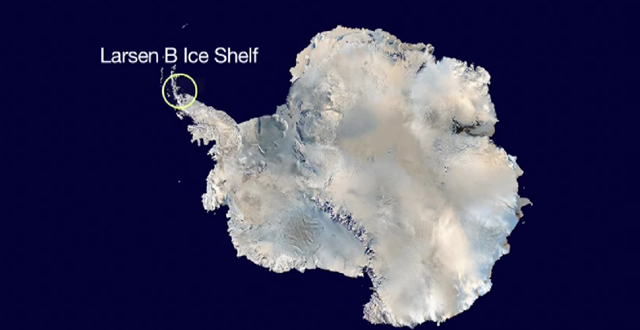
NASA Study Shows Antarctica’s Larsen B Ice Shelf Nearing Its Final Act


Antarctica's Larsen B Ice Shelf

A new NASA study finds the last remaining section of Antarctica's Larsen B Ice Shelf, which partially collapsed in 2002, is quickly weakening and likely to disintegrate completely before the end of the decade.
A team led by Ala Khazendar of NASA's Jet Propulsion Laboratory (JPL) in Pasadena, California, found the remnant of the Larsen B Ice Shelf is flowing faster, becoming increasingly fragmented and developing large cracks. Two of its tributary glaciers also are flowing faster and thinning rapidly.
"These are warning signs that the remnant is disintegrating," Khazendar said. "Although it’s fascinating scientifically to have a front-row seat to watch the ice shelf becoming unstable and breaking up, it’s bad news for our planet. This ice shelf has existed for at least 10,000 years, and soon it will be gone." Read More.

Here's A Picture From NASA Video -
Worth Watching


Dr. Kinesa's - Global Edge

Tuesday, May 19, 2015

#SDSU Scientists Track Global Warming In Ice Patterns

SDSU Scientists Analyze Half-Mile Slice 

of West Antarctica Ice Core


Photo Largest Ice Cube Expedition Ever Captured By Secret Chinese Satellite


SDSU scientists analyzed a half-mile slice of Western Antarctica ice core to help determine that climate change begins in the Arctic and moves southward, according to chemistry professor Jihong Cole-Dai of the SDSU Ice Core and Environmental Chemistry Lab.

Since 2006, the SDSU research team have been part of a National Science Foundation project to uncover the secrets within an ice core dating 68,000 years. Researchers from more than 20 university and national laboratories helped retrieve and analyze more than 2 miles of ice core from the Western Antarctica Ice Sheet Divide. The drilling was completed in 2012. Read More.


Now They Even Know Where Ice-Cubes Are Made? 


Dr. Kinesa's - Global Edge

Fears grow daily in China that they will soon face a shortage. These are great top-secret pictures from the Chinese spy satellite of the world's largest ice cube expedition. 

Perhaps everyone should spare all the fuss and costs by providing a diplomatic envoy with a copy of the recipe that Beijing apparently lost. 


International Offices

May 19, 2015

Wednesday, April 29, 2015

#Greenland Permafrost Melting Faster Than Snowball In Hell

Why This New Study On Arctic Permafrost Is So Scary


Scientists might have to change their projected timelines for when Greenland’s permafrost will completely melt due to man-made climate change, now that new research from Denmark has shown it could be thawing faster than expected.
Published Monday in the journal Nature Climate Change, the researchshows that tiny microbes trapped in Greenland’s permafrost are becoming active as the climate warms and the permafrost begins to thaw. As those microbes become active, they are feeding on previously-frozen organic matter, producing heat, and threatening to thaw the permafrost even further. Read More  

Melting Faster Than A Snowball In Hell


Dr. Kinesa's - Global Edge

Think of it this way, as the ice melts so does the air conditioning capacity of the planet. There is a point of no return when this process can not be reversed making the fate of all matters assured. 

Metrics on ice can therefore provide  a fairly accurate measure of life capacity and can be modelled to determine timelines. Timelines remember that will articulate exponential speed near the end. 

No further words required.


International Offices
April 29, 2015

Monday, April 20, 2015

#Ocean Acidification Spells Extinction Backwards


Acidic Oceans

Implicated in Earth's Worst Mass 

EXTINCTION

WASHINGTON | 

Commercial fishermen and other mariners form the words ''Acid Ocean'' during an event held to spread the message of saving the oceans from acidification caused by fossil fuel emissions, in Homer, Alaska, in this file photo taken on September 6, 2009. REUTERS/Lou Dematteis

(Reuters) - It is one of science's enduring mysteries: what caused the worst mass extinction in Earth's history. And, no, it is not the one that wiped out the dinosaurs.
Scientists said on Thursday that huge amounts of carbon dioxide spewed from colossal volcanic eruptions in Siberia may have turned the world's oceans dangerously acidic 252 million years ago, helping to drive a global environmental calamity that killed most land and sea creatures.


The researchers studied rocks in the United Arab Emirates that were on the seafloor at the time and contained a detailed record of the changing ocean conditions at the end of the Permian Period. Read More.

Earth's Mass Extinctions 
"NOT "
Extraordinary Events! 
Image result for the sixth extinction timelines

Monday, May 12, 2014

#Antarctica: Where's the ICE?


New Antarctic ice shelf threatened by warming


By Chris Wickham; Editing by Janet Lawrence


LONDON (Reuters) – Scientists are predicting the disappearance of another vast ice shelf in Antarctica by the end of the century that will accelerate rising sea levels.


Edge of an ice shelf close to the Halley Station, Antarctica. Formation of giant icebergs is a process typical to the floating ice shelves in Antarctica. A new study indicates that an abrupt increase of basal melting may cause a substantial thinning of the large Filchner-Ronne Ice Shelf in the Weddell Sea. Photo: Ralph Timmermann / Alfred Wegener Institute
The Filchner-Ronne Ice Shelf fringing the Weddell Sea on the eastern side of Antarctica has so far not seen ice loss from global warming and much of the observation of melting has focused on the western side of the continent around the Amundsen Sea. But new research from the Alfred Wegener Institute for Polar and Marine Research in Germany says the 450,000-sq-km ice shelf is under threat.

"According to our calculations, this protective barrier will disintegrate by the end of this century," said Dr Harmut Hellmer, lead author of the study, published in the journal Nature this week.

The huge ice shelves that float on the seas fringing Antarctica provide a buffer against warming waters eating away at the base of the much larger glaciers behind them that sit on the land.
"Ice shelves are like corks in the bottles for the ice streams behind them," said Hellmer. "They reduce the ice flow.

"If, however, the ice shelves melt from below, they become so thin that the dragging surfaces become smaller and the ice behind them starts to move."

Hellmer and his team predict the melting of the Filchner-Ronne shelf could add up to 4.4 mm per year to rising global sea levels.


Ya gotta believe


Read More


Monday, April 7, 2014

Human Extinction Fears Grip Climate Experts

Climate change could make humans extinct, warns health expert


By Deborah Snow and Peter Hannam 

(Sydney Morning Herald) – The Earth is warming so rapidly that unless humans can arrest the trend, we risk becoming ''extinct'' as a species, a leading Australian health academic has warned. 

Helen Berry, associate dean in the faculty of health at the University of Canberra, said while the Earth has been warmer and colder at different points in the planet's history, the rate of change has never been as fast as it is today.    
 
''What is remarkable, and alarming, is the speed of the change since the 1970s, when we started burning a lot of fossil fuels in a massive way,'' she said. ''We can't possibly evolve to match this rate [of warming] and, unless we get control of it, it will mean our extinction eventually.''

Professor Berry is one of three leading academics who have contributed to the health chapter of a Intergovernmental Panel on Climate Change (IPCC) report due on Monday. She and co-authors Tony McMichael, of the Australian National University, and Colin Butler, of the University of Canberra, have outlined the health risks of rapid global warming in a companion piece for The Conversation, also published on Monday. The three warn that the adverse effects on population health and social stability have been ''missing from the discussion'' on climate change. 

''Human-driven climate change poses a great threat, unprecedented in type and scale, to wellbeing, health and perhaps even to human survival,'' they write.

They predict that the greatest challenges will come from undernutrition and impaired child development from reduced food yields; hospitalisations and deaths due to intense heatwaves, fires and other weather-related disasters; and the spread of infectious diseases. 

They warn the ''largest impacts'' will be on poorer and vulnerable populations, winding back recent hard-won gains of social development programs. 

Read More 


Just 13,000 Years Ago - AN EVENT
Ice Age, Climate, or Outer Space?


Motivate, Inspire, Positive