Over 1.5 Million International FOLLOWERS AND Readers have engaged our various digests and blogs providing insights on the "SEVEN BIG Es" - Earth, Economics, Environment, Energy, Exponentiation, Entropy, and Extinction, curated by our world renowned "Quantum Realonomist" - First Financial Insights Inc. - Dr. Peter G Kinesa
WORLD LEADING INSIGHTS
International LEADERS Calling Market Crashes Years Ahead
Second to None, Anywhere...
'Warned 2000 tech slide; predicted 2008 meltdown in 2007. Forecasted 2020 global economic collapse in 2011, AND NOW- BY 2050 - THE MOTHER OF ALL CRASHES"
China Takes On Pollution With Biggest Changes in 25 Years
BEIJING (Bloomberg News) – China’s legislature passed the biggest
changes to its environmental protection laws in 25 years, punishing
polluters more severely as the government works to limit smog and
contaminated water and soil linked to three decades of economic growth.
Amendments to the law “sets environmental protection as the
country’s basic policy,” the official Xinhua News Agency reported
yesterday. The rules hadn’t been changed since first enacted in 1989 as
China began consuming more energy as the most-populous country grew into
a global manufacturing hub.
Now the world’s biggest carbon
emitter, China has moved to address the environmental damage that has
been a byproduct of its breakneck economic growth and become a leading
cause of social unrest. Government reports and recent comments from top
officials about pollution have revealed the extent of the damage and
health issues related to China’s soil, water, and air.
The
amendments give the public and government “powerful new tools” to cut
pollution, Barbara Finamore, senior attorney and Asia director at the
Natural Resources and Defense Council in New York, said in an interview.
“The pollution is now impossible to ignore,” she said. “This is very
big news.”
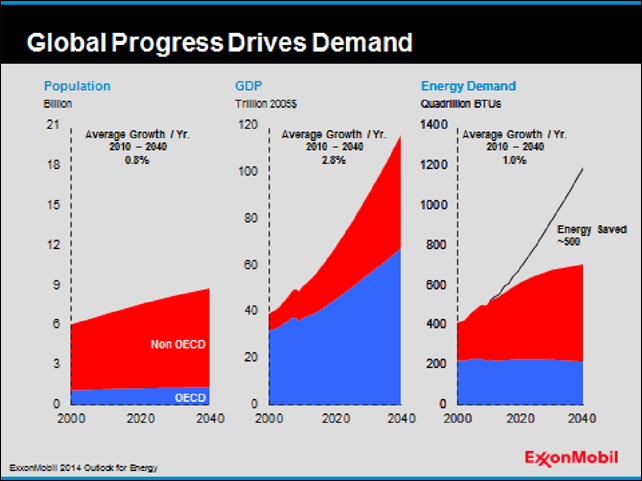
Exxon Mobil says climate change unlikely to stop it selling fossil fuels Oil giant issues report on risks that climate policies could pose to the value of its assets and future profitability
1 April 2014 (Associated Press) – On the same day the world's scientists issued their latest report on climate change and the risks it poses to society, America's biggest oil and gas company said the world's climate policies are "highly unlikely" to stop it from selling fossil fuels far into the future.
Both Exxon and its critics used IPCC research to bolster their cases.
Exxon's report was in response to the contentions of some shareholders and environmental activists that the assets underpinning the value of Exxon and other fossil fuel companies will be worth less as society restricts consumption of fossil fuels to fight climate change.
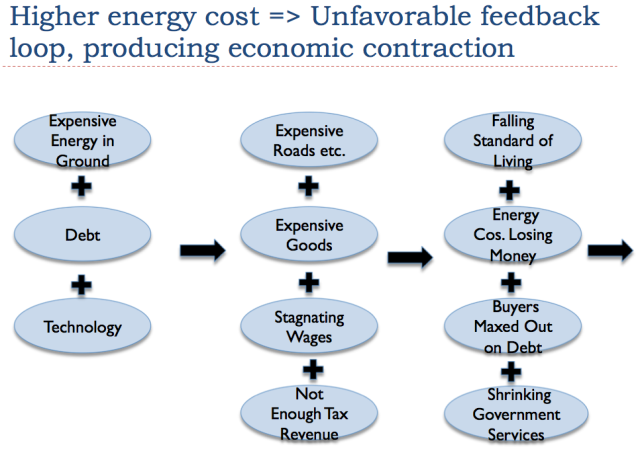
What is the correct way to model the future course of energy and the economy? There are clearly huge amounts of oil, coal, and natural gas in the ground. With different approaches, researchers can obtain vastly different indications. I will show that the real issue is most researchers are modeling the wrong limit. (Read More)
Comments: There is one economic observation that is profound and pervasive to all global physical-economic theory, metrics and activity. That is the strong positive correlation that energy use; particularly oil, has with the exponential growth in GDP, stock markets, food production, population and a host of other outcomes, over the past 150 years. That is why it is extremely important to know and understand that when this trend turns southwards its implications will have extra-ordinary effects on the nature, extent and quality of all human activity. Nothing is more important than this in so many respects. Dr Peter G Kinesa March 22, 2014
(Washington Post) – As the
climate warms, forest fires in the West increasingly will feast on acres
of dry brush, growing into giants. In a cycle that will become routine,
homeowners will flee, while firefighters will rush toward their houses —
and away from areas where they could be putting out wildfires.
Bigger, unwieldy burns — megafires — are becoming the new normal, according to a new report,
which points to several reasons: States such as California are getting
parched more frequently by drought; housing developments are pushing
more deeply into forests; and the U.S. Forest Service is generally
suppressing fires rather than letting them burn naturally, which would
reduce the brush that fuels future fires.
“That’s one of our
biggest conundrums,” said Scott L. Stephens, a professor of fire science
at the University of California at Berkeley. “We continue building. We
make fire management so much more difficult. The first thing you’re
going to do is run and protect people’s homes.” In 1993, the
average cost of fighting wildfires was $350 million a season. Now, it’s
$2 billion, said Stephens, the lead author of “Temperate and boreal
forest mega-fires: characteristics and challenges,” published recently
in the journal Frontiers in Ecology and the Environment.
“The
cost is going up, and one reason is the extreme amount of resources that
has to be put into putting out fires near an urban interface,” Stephens
said. “Having those houses there . . . man, that gets expensive. A fire
engine every four, five or six houses, and there are hundreds of houses
out there.”
The review’s conclusions underscore what the
agencies responsible for fighting wildfires — the Interior Department
and the Agriculture Department’s Forest Service — have said for years, (Read More)