WORLD LEADING INSIGHTS

International LEADERS Calling Market Crashes Years Ahead
Second to None, Anywhere...

'Warned 2000 tech slide; predicted 2008 meltdown in 2007. Forecasted 2020 global economic collapse in 2011, AND NOW- BY 2050 - THE MOTHER OF ALL CRASHES"

Featured Post

#TROUBLE AHEAD AS #ICE SHELF DEVASTATED IN #ANTARCTIC

 REUTERS Thinning Antarctic ice shelf finally crumbles after heatwave By  Isla Binnie March 25 (Reuters) - An East Antarctica ice shelf disi...

Inspire, Achieve, Success

Search This Blog

SAVE ON HOT STUFF

Showing posts with label countdown. Show all posts

Friday, April 11, 2014

Plastic Garbage Killing Oceans


Is 20 millions tons enough? Scientists recommend plastic crackdown as oceans chok
Read more at http://news.mongabay.com/2014/0402-samoray-plastic-ocean.html#s5Z29cFSclFcXDmi.99
Is 20 millions tons enough? Scientists recommend plastic crackdown as oceans choke
Read more at http://news.mongabay.com/2014/0402-samoray-plastic-ocean.html#s5Z29cFSclFcXDmi.99
Is 20 millions tons enough? Scientists recommend plastic crackdown as oceans choke
Read more at http://news.mongabay.com/2014/0402-samoray-plastic-ocean.html#s5Z29cFSclFcXDmi.99
Animals readily mistake plastic floating in the ocean for food. This albatross chick likely starved after it was fed too much plastic by its parents. Photo courtesy of the U.S. Fish and Wildlife Service.Is 20 Million Tons  Enough. Scientists say Oceans are choking


By Chris Samoray 


(Mongabay.com) – Every year, 20 million tons of plastic enters the world’s oceans. In 2012, the Rio +20 United Nations Conference on Sustainable Development dubbed marine plastic litter “a major environmental issue that the world must address,” and asked for management action by 2025. One group of researchers started early and was among the first to take on the Rio +20 call to tackle marine plastic pollution, presenting a “Top Ten” list of recommendations ranging from international treaties to public education and awareness programs. 


Marine debris litters a beach on Laysan Island in the Hawaiian Islands National Wildlife Refuge. Photo: U.S. Fish and Wildlife Service
“Plastic marine litter is far more than an aesthetic problem,” writes the team from the UCLA Institute of the Environment and Sustainability in a study published in UCLA’s Pritzker Environmental Law and Policy Briefs [pdf]. “Increasing harm to marine wildlife and rising economic costs provide an enormous incentive to tackle the global plastic marine litter problem more aggressively.” 


New Breed of Fish?
The team suggests that international cooperation is among the most urgent action needed to better control marine plastic waste. One of their recommendations is an international treaty on par with the 1989 Montreal Protocol—an international treaty designed to protect the ozone layer—that would employ strong monitoring, tracking and reporting practices, along with marine litter standards enforceable on a global scale.


Another international treaty the team ...


Read More 

Or watch more ...

Friday, April 4, 2014

IPCC: Climate Report Maps Out Human Fate?


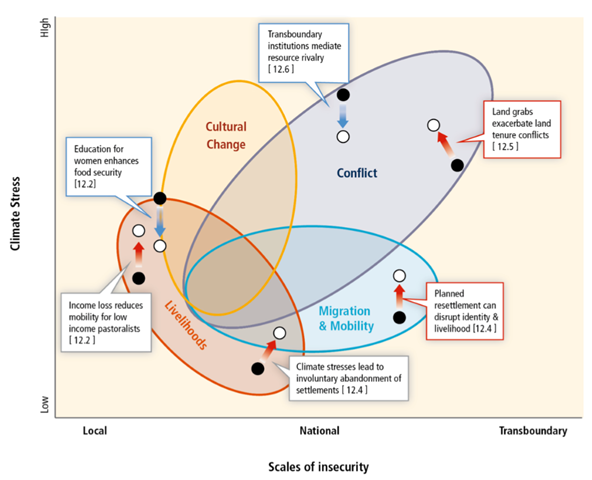
Human security will be progressively threatened as the climate changes. Human insecurity almost never has single causes, but instead emerges from the interaction of multiple factors. Climate change is an important factor in threats to human security through (i) undermining livelihoods, (ii) compromising culture and identity, (iii) increasing migration that people would rather have avoided, and (iv) challenging the ability of states to provide the conditions necessary for human security. Graphic: IPCC WGII AR5
Climate Change - Possible Human Complexities


More and More Truths...

30 March 2014 (IPCC) – The Final Draft Report, dated 28 October 2013, of the Working Group II contribution to the IPCC Fifth Assessment ReportClimate Change 2014: Impacts, Adaptation, and Vulnerability was 
accepted but not approved in detail by the 10th Session of Working Group II and the 38th Session of the IPCC on 29 March 2014 in Yokohama, Japan. It consists of the full scientific and technical assessment undertaken by Working Group II.
The Final Draft Report has to be read in conjunction with the document entitled “Climate Change 2014: Impacts, Adaptation, and Vulnerability. Working Group II Contribution to the IPCC 5th Assessment Report — Changes to the Underlying Scientific/Technical Assessment” to ensure consistency with the approved Summary for Policymakers (IPCC-XXXVIII/DOC.4) presented to the Panel at its 38th Session. This document lists the changes necessary to ensure consistency between the full Report and the Summary for Policymakers, which was approved line-by-line by Working Group II and accepted by the Panel at the above-mentioned Sessions. A listing of substantive edits additionally indicates corrections of errors for the Final Draft Report.

ASSESSING AND MANAGING THE RISKS OF CLIMATE CHANGE 

Human interference with the climate system is occurring, and climate change poses risks for human and natural systems (Figure SPM.1). The assessment of impacts, adaptation, and vulnerability in the Working Group II contribution to the IPCC’s Fifth Assessment Report (WGII AR5) evaluates how patterns of risks and potential benefits are shifting due to climate change. 
It considers how impacts and risks related to climate change can be reduced and managed through adaptation and mitigation. The report assesses needs, options, opportunities, constraints, resilience, limits, and other aspects associated with adaptation. 

Read More


The same old song... with the same meaning


For fun - no holds barred today. But these guys at the IPCC must think that we are all really stupid. They present a graph with a bunch of circles, add some pretty colours and words. Then presto! All our problems are defined and thus somehow possibly within their control or ability to fix. Now should we all walk away with the comfort and knowledge that these folks have humanity's fate well in hand? Sorry, but nothing could be further from the truth..

Why? Because the now world -famous Kinesa Climate Change Curve (KCCC)  looks extremely different in comparison. First, draw a  straight 12 inch vertical line from the left to the right side of a page. Call it lapsed time 

Then draw a horizontal line somewhere along the vertical line. Call it climate order. Remember too, that the vertical line continues on and on for miles and miles at both ends. There you go - your very own  KCCC graph with a very different story.

What do you  mean it doesn't curve? Actually it does,  if you look close enough!

Dr. Peter G Kinesa
April 4, 2014   


A Final Word


No Kidding...

Motivate, Inspire, Positive