WORLD LEADING INSIGHTS

International LEADERS Calling Market Crashes Years Ahead
Second to None, Anywhere...

'Warned 2000 tech slide; predicted 2008 meltdown in 2007. Forecasted 2020 global economic collapse in 2011, AND NOW- BY 2050 - THE MOTHER OF ALL CRASHES"

Featured Post

#TROUBLE AHEAD AS #ICE SHELF DEVASTATED IN #ANTARCTIC

 REUTERS Thinning Antarctic ice shelf finally crumbles after heatwave By  Isla Binnie March 25 (Reuters) - An East Antarctica ice shelf disi...

Inspire, Achieve, Success

Search This Blog

SAVE ON HOT STUFF

Monday, September 12, 2016

Growing Concern 6th Mass #Extinction Well Underway

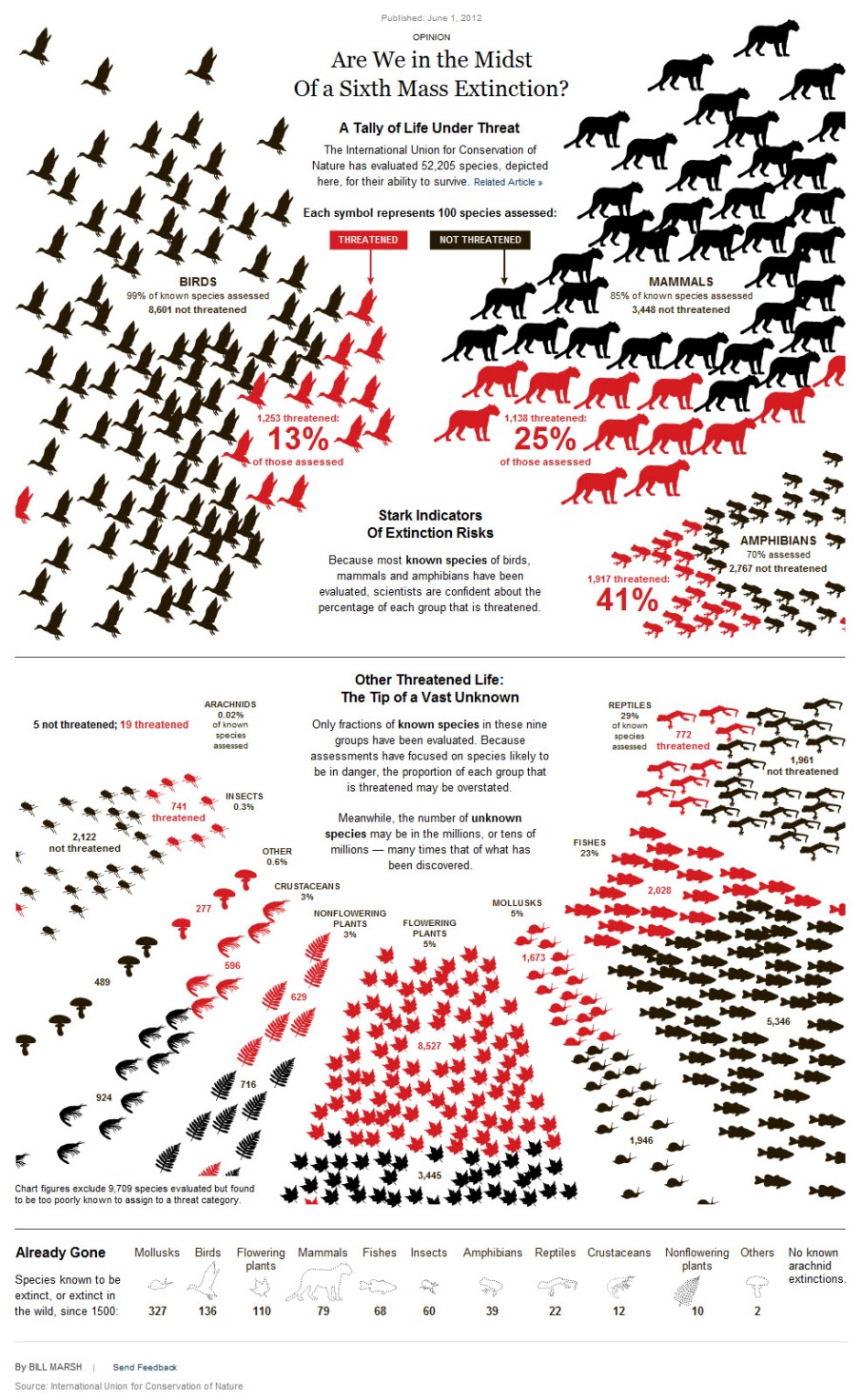
Are We in the Midst of a Sixth Mass Extinction

Infographic: Are We in the Midst of a Sixth Mass Extinction?

Are We in the Midst of a Sixth Mass Extinction? by Bill Marsh, Sunday Review Graphics Editor, New York Times
Bill Marsh’s black-and-red image depicts species at risk of extinction, based on data from the International Union for Conservation of Nature. When it comes to designing infographics, Marsh says there’s a dance between visual appeal and clarity of information. For example, he chose a big cat to represent all mammals because, “right away [they] convey that we’re talking about a certain type of animal, and big cats in particular are threatened.” To signify threatened flowering plants, he chose a maple leaf, because not all flowering species have the typical floral bloom. “We didn’t want to give people the wrong impression by literally selecting a flower image,” he says.

Infographic

Death on a pale horse is one of the traditional four horsemen of the apocalypse from Revelations.


How humans are driving the sixth mass extinction

Scientists have been warning for decades that human actions are pushing life on our shared planet toward mass extinction. Such extinction events have occurred five times in the past, but a bold new paper finds that this time would be fundamentally different. Fortunately, there’s still time to stop it.


Impeachment of Dilma Rousseff

Privatization on a massive scale will take place in the coming years – perhaps comparable to Greece. Privatization will be accompanied by austerity programs, cutting of health and education benefits, of pensions and other social safety nets.


Coca-Cola Accused of Funding Colombian Death Squad

Coca-Cola along with more than 50 other companies were accused by Colombian courts of financing terrorism for their ties to the now-disbanded paramilitary organization.


China Plans To Boost Electric Vehicle Sales 10-Fold

While Tesla racks up a record-setting 400,000 presales for its affordable Model 3 due out next year, the world’s leading EV maker, China’s BYD, has already sold more EVs than Tesla, GM, and Nissan combined!


Community-scale solar can power corporations, too

Corporations are entering the renewables market in force, and they will find much to like in the community-scale solar market segment.



Image result for poor americans


If Everything Is So Great, How Come I’m Not Doing So Great?

While the view might be great from the top of the wealth/income pyramid, it takes a special kind of self-serving myopia to ignore the reality that the bottom 95% are not doing so well.
We're ceaselessly told/sold that the U.S. economy is doing phenomenally well in our current slow-growth world -- generating record corporate profits, record highs in the S&P 500 stock index, and historically low unemployment (4.9% in July 2016). 


While GDP growth is somewhat lackluster by historical standards—less than 2% in 2016—it's growth nonetheless. And the rate of consumer-price inflation is hovering around 1%; negligible by historical standards.
But this uniformly positive statistical view of the U.S. economy raises a question among those not in the top 0.1%: If everything’s going so great, how come I’m not?
Whether it's struggling to keep up with the rising cost of living, a 0% return on savings, working longer hours while real wages stagnate, scrimping to pay back education loans, despairing at the abuses of power in our banking and political systems, or lamenting the loss of nourishing social interaction in our increasingly isolated and digital lifestyle — most "regular" people find their own personal experiences to be at odds with the rosy "Everything is awesome!" narrative trumpeted by our media.

The Scorecard
To get a more concrete understanding of this gap, let's establish a scorecard we can individually fill in to make an assessment of just how well we’re doing.

Friday, September 9, 2016

Earth's Future At Risk As Great Apes Face Extinction


Honolulu, Hawaiʻi, 4 September 2016 (IUCN) – The Eastern Gorilla – the largest living primate – has been listed as Critically Endangered due to illegal hunting, according to the latest update of The IUCN Red List of Threatened Species™ released today at the IUCN World Conservation Congress taking place in Hawaiʻi. Four out of six great ape species are now Critically Endangered – only one step away from going extinct – with the remaining two also under considerable threat of extinction.

Eastern Gorilla


Four out of six great apes one step away from extinction – IUCN Red List


Today’s IUCN Red List update also reports the decline of the Plains Zebra due to illegal hunting, and the growing extinction threat to Hawaiian plants posed by invasive species. Thirty eight of the 415 endemic Hawaiian plant species assessed for this update are listed as Extinct and four other species have been listed as Extinct in the Wild, meaning they only occur in cultivation.
The IUCN Red List now includes 82,954 species of which 23,928 are threatened with extinction.
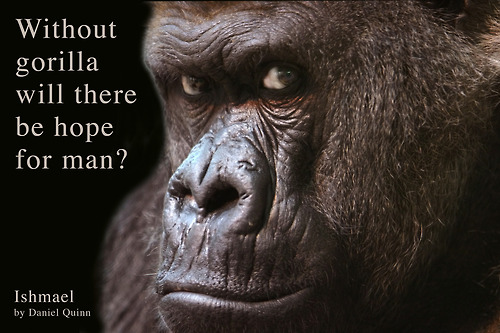
Image result for ishmael gorilla

Mammals threatened by illegal hunting
The Eastern Gorilla (Gorilla beringei) – which is made up of two subspecies - has moved from Endangered to Critically Endangered due to a devastating population decline of more than 70% in 20 years. Its population is now estimated to be fewer than 5,000. Grauer’s Gorilla (G. b. graueri), one subspecies of Eastern Gorilla – has lost 77% of its population since 1994, declining from 16,900 individuals to just 3,800 in 2015. Killing or capture of great apes is illegal; yet hunting represents the greatest threat to Grauer’s Gorillas. The second subspecies of Eastern Gorilla – the Mountain Gorilla (G. b. beringei) –is faring better and has increased in number to around 880 individuals. Four of the six great apes - Eastern Gorilla, Western Gorilla, Bornean Orangutan and Sumatran Orangutan - are now listed as Critically Endangered, whilst the Chimpanzee and Bonobo are listed as Endangered.
“To see the Eastern gorilla – one of our closest cousins – slide towards extinction is truly distressing,” says Inger Andersen,IUCN Director General. “We live in a time of tremendous change and each IUCN Red List update makes us realize just how quickly the global extinction crisis is escalating. Conservation action does work and we have increasing evidence of it. It is our responsibility to enhance our efforts to turn the tide and protect the future of our planet.”

Image result for ishmael book

https://youtu.be/d7LRc-tt4kM


Death Knell' for TTIP as France Calls for End of Talks

"The negotiations are bogged down, positions have not been respected, it's clearly unbalanced," 

Hillary Clinton’s Honduran problem

While secretary of state, Clinton supported new elections after the 2009 coup to prevent the return of left wing president Manuel Zelaya. What followed was a sell-off of mining and hydroelectric concessions that have contributed to the poverty Honduras’ current political instability.
Greenpeace brought the Reef to Canberra

We set up a huge coral garden of 300 coral-like cutouts on the front lawn of Parliament House, to bring home to our new leaders what’s at stake if we don’t act fast enough on climate change.


Image result for shoeshine boy recommends stocks

The Marginal Buyer Holds The Pin That Pops Every Asset Bubble


So it's important to watch him very closely


Q: How much is my house worth?
A: Whatever the highest bidder is willing to pay for it.

The Housing Market: Poised For Another Crash?


Those of you who took an introductory Economics class in high school or college may remember learning that prices are set "at the margin". That's a fancy way to say that prices are set by the person (or people) willing to pay the most.
This person willing to pay top dollar is called the "marginal buyer". Most of us don't really think about him much, but he (or she) is very, very important.
Why? Because the marginal buyer not only determines price levels, but also their stability and degree of volatility. The behavior of the marginal buyer, as well as the degree of competition for his/her "top dog" spot, sets the prices of nearly every asset class held by today's investors.
Imagine for a moment an auction room, filled with people holding their bidding paddles. A rare Picasso painting is brought to the block. Paddles all around the room compete furiously as the auction starts; but as the bid price rises higher and higher, fewer and fewer paddles participate in the bidding. Pretty soon, it's down to just two bidders dueling back and forth with one another. Then, after a stunningly high bid of $106.5 million dollars, no more paddles are raised. The marginal buyer has been found. No one is willing to outbid his price. (For the record, this is exactly what happened back in 2010 when Picasso's Nude, Green Leaves and Bust came up for sale.)
This example contains several important elements for price-setting. First: the marginal buyer's last bid is what ends up setting the final price. And second: the intensity of competition determines how high the marginal buyer's bid will go (if no one else was willing to offer more than say, $10 million, it's unrealistic to expect that the marginal buyer would have still put in a bid as astronomically high as $106.5 million).
Now imagine what would have happened if our marginal buyer above hadn't shown up for the auction. Maybe he got stuck in traffic, or decided he'd rather own a tropical island instead of a wall hanging. How much would the painting have sold for then?
It would have sold at a price lower than the losing bidder's last offer. Without our hero in the room, the losing bidder would have become the new marginal buyer. And without the threat from a competitor with deeper pockets, it's quite likely our new marginal buyer would have been able to secure the painting at a substantially lower price.

Not Good For Stock Market - 
Low Volumes Means Fewer Paddles 


Motivate, Inspire, Positive